AI + CTV in 2026
How Advertisers Turn Streaming Attention into Revenue
Executive Summary
CTV became mainstream in 2025.
Most people watched TV via streaming bundles, FAST, and smart TV platforms in 2025. Now, instead of treating CTV as a separate line item, advertisers are measuring CTV alongside search, social, and retail media.
AI is now core to creative and media workflows.
New generative AI tools can turn URLs and briefs into CTV-ready spots in days. That helps smaller brands afford to show up on the big screen, and enables larger brands to test more ideas without spinning up full new campaigns.
2026 will be about focus and discipline.
The leaders who succeed next year will start every program with a measurement plan, build AI-assisted creative engines, connect CTV to CRM and retail data, and put simple guardrails around AI use.
What AI + CTV Looked Like in 2025…
We’re seeing advertisers plan CTV and linear together, then use digital-style measurement to understand which combinations actually move the needle for their business.

Streaming rebuilt TV around apps.
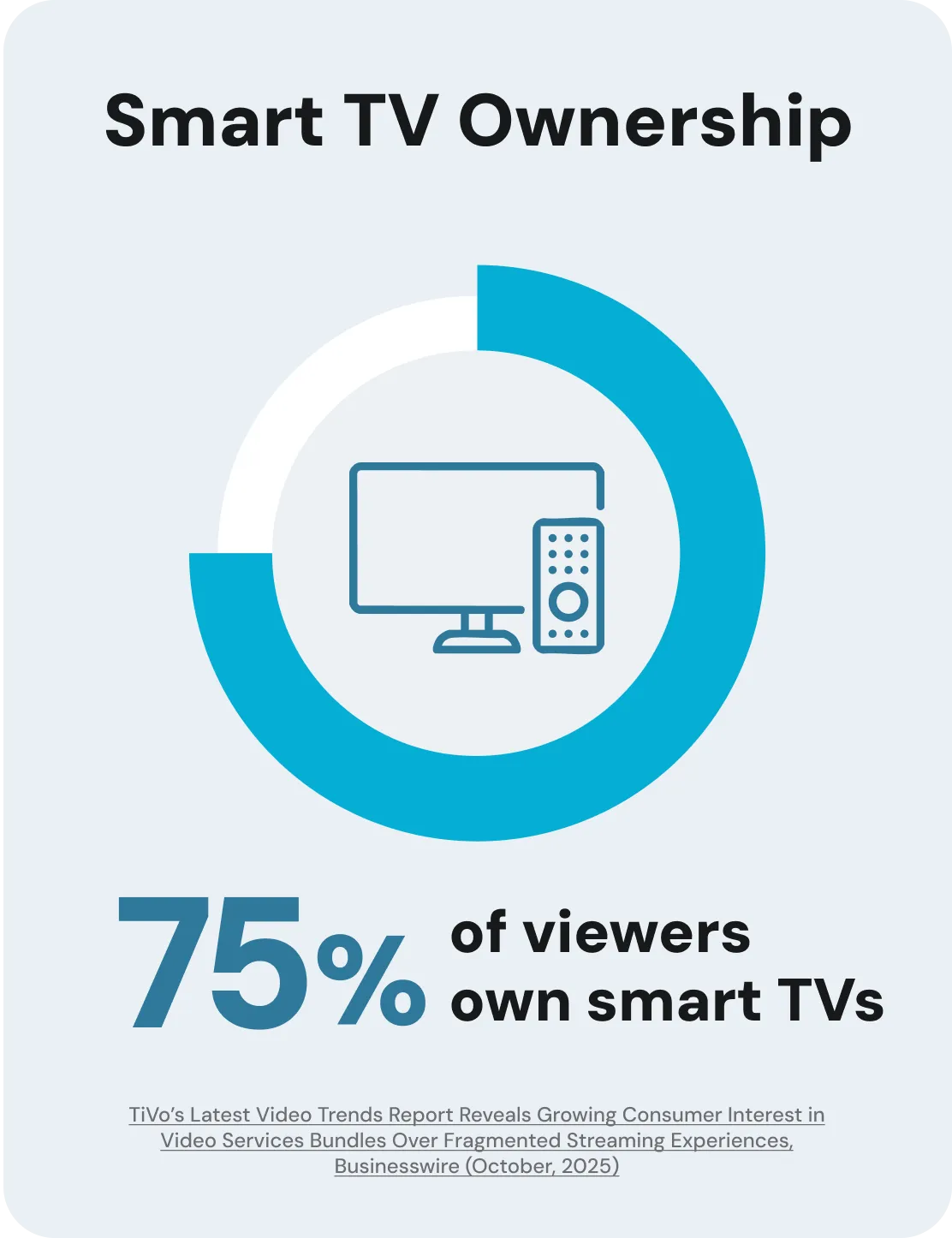
Most viewers stitched together their own cable lineup in 2025. Fans watched live sports, prestige dramas, local news, and niche content through a mix of streaming bundles, free ad-supported TV (FAST), and smart TV apps. Local content also climbed as a share of viewing time. And with smart TVs now sitting in most living rooms, the TV OS itself was a powerful gatekeeper.
But for many, this was simply "TV." In fact, the average household used around 10 video services and spent well over $100 per month on subscriptions alone last year. Meanwhile, many of those who cut the cord in previous years quietly returned to paid TV bundles as app fatigue, sign-in friction, and rising monthly costs added up.


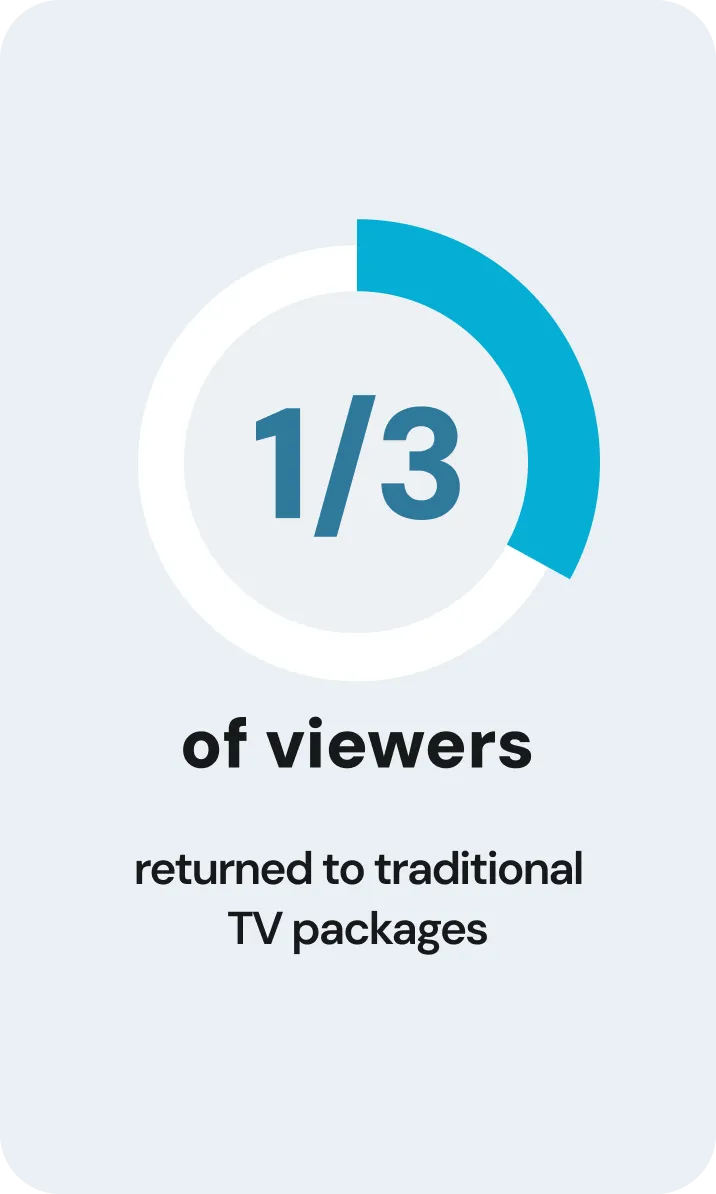
Tivo's Latest Video Trends Reveals Growing Consumer Interest in Video Services Bundles Over Fragmented Streaming Experiences, Businesswire (October, 2025)
Attention shifted to the biggest screen.
A new attention split also emerged. Short-form feeds on phones and laptops still dominate daily frequency, but high-attention time increasingly lives on the TV screen. In that context, connected TV (CTV) began competing with the best content in the world in a setting where viewers have settled in to watch, not just scroll.
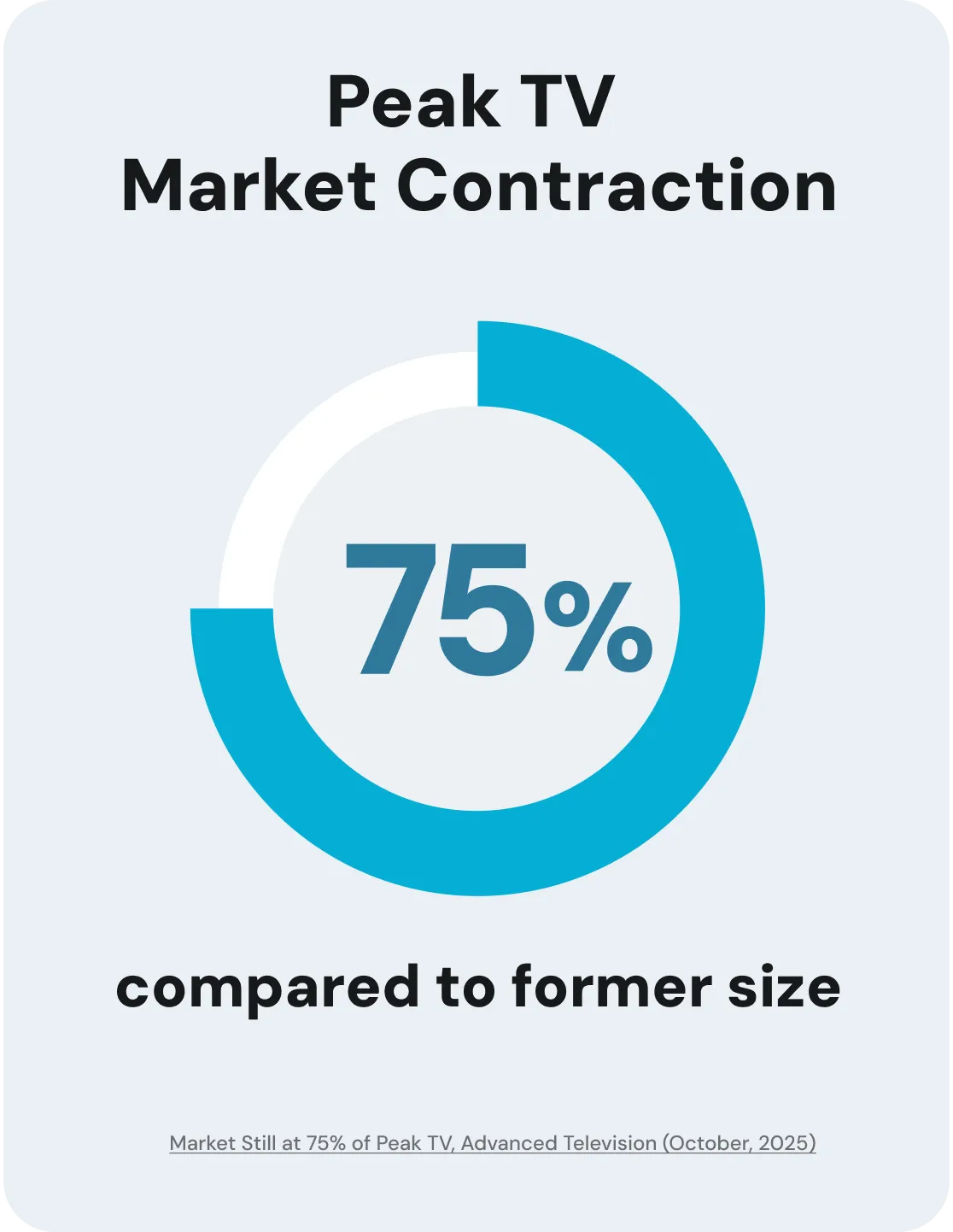
You’re not just buying a network anymore—you’re buying a behavior, a mood, and a household.

Sports illustrated the shift clearly.
Many of the games that once felt tied to a single broadcast network moved to streaming packages, league-owned apps, and hybrid deals that blend linear and CTV. Fans followed their teams into these environments, bringing strong emotion and household co-viewing with them.
Journeys were longer and multi-channel.
The customer journey has become a maze. A single purchase could involve dozens of touchpoints—streaming awareness, reminders in social feeds, branded search, email, and on-site experiences.
In that mix, CTV became an active part of the performance stack. QR codes, shoppable overlays, and device graphs linked big-screen exposure to site visits, app opens, and retail transactions. When those signals connected back to CRM and retail systems, advertisers could see how CTV influenced both upper- and lower-funnel behavior.
AI transformed creative functions.
Generative AI officially claimed its seat within creative tools and ad platforms, reducing the cost and time required to deliver high-quality video to the big screen. Today's teams can:
- Turn a URL or brief into a draft script, storyboard, and voiceover in minutes.
- Generate multiple variations of the same concept for different audiences, lengths, and placements.
- Produce spec ads for every prospect in a sales pipeline instead of a handful of high-priority accounts.
Smaller and mid-sized advertisers are starting to show up in CTV environments that once felt out of reach, while larger advertisers can test more ideas and "seasons" of creative without having to build an entire campaign from scratch
AI is raising the floor, but I’m not sure it’s raised the ceiling yet. If you don’t start with a strong creative idea, you’re just generating more variations of average.

That’s why retail media is growing so fast—it’s measurable.

Measurement expectations changed.
Finally, expectations around measurement also grew. As more TV inventory flowed through programmatic pipes, buyers were increasingly able to see:
- Which shows, networks, and bundles deliver the most efficient reach into target audiences.
- How specific creatives drive site visits, lead submissions, or store traffic.
- How CTV compares, side by side, with search, social, and retail media on cost and impact.
At the same time, many teams still depended heavily on platform-reported metrics and a mix of legacy TV panels, log-level data, and modelled outcomes. The appetite for closed-loop attribution and independent verification is growing faster than the systems that support it. Leaders see both opportunity and risk in this new AI + CTV environment.
75%
% of customers who use multiple channels in a single transaction. (Cresta, 2025)
53%
% of customers who expect personalization at every touchpoint. (Cresta, 2025)
Legacy metrics don’t deliver value.
Fewer than 20% of AI-handled conversations reach successful resolution. In other words, most AI systems today assist with parts of the interaction, but still need humans to close the loop.
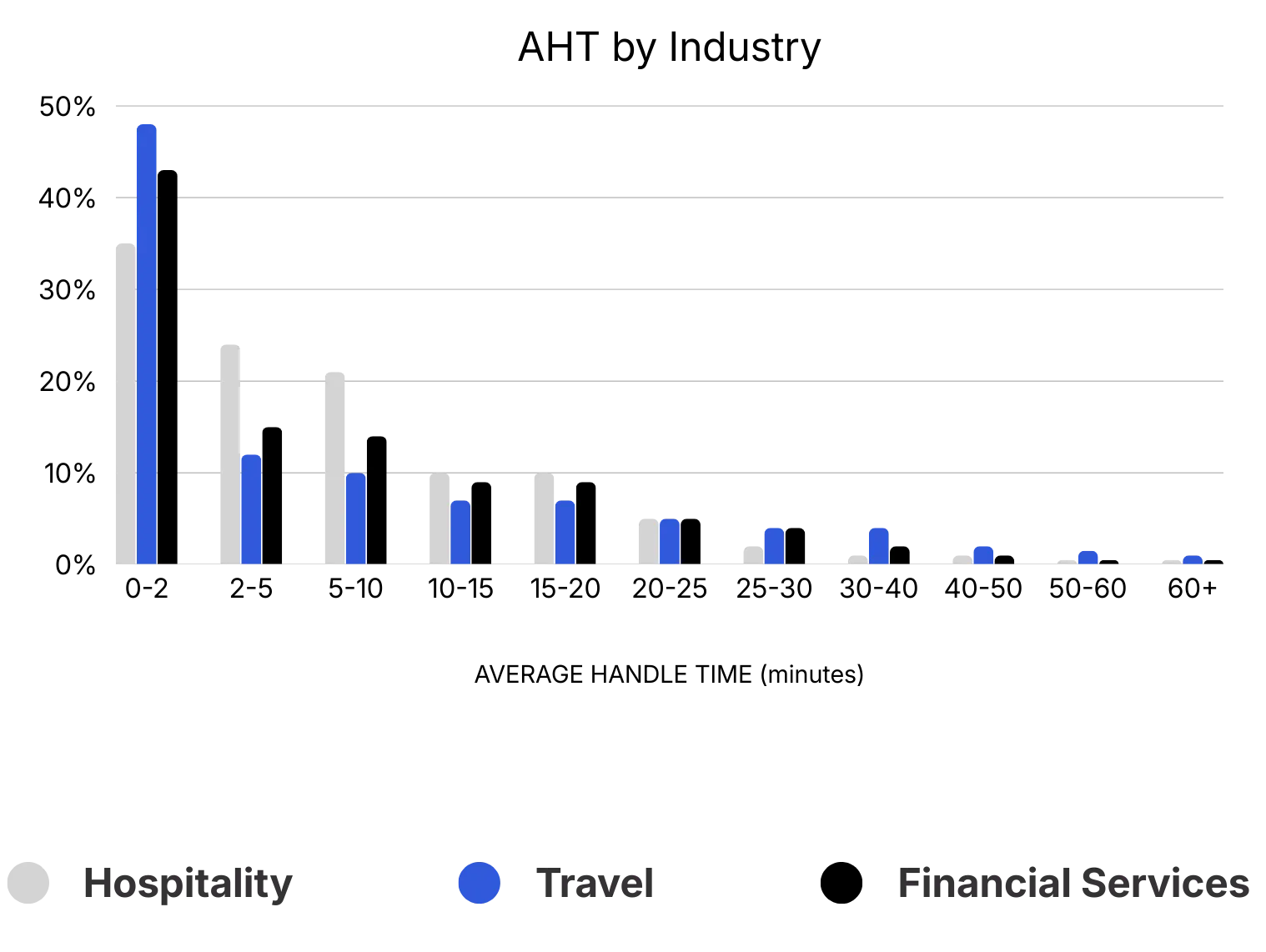
Why Driving Down Average Handle Time is Costing You Money, Cresta (2024).
Coaching patterns show a similar mismatch.
In most cases, increasing the number of coaching sessions does not reliably improve behavioral adherence. Because sessions aren't targeted at the specific behaviors driving outcomes, many teams spend more time in coaching meetings without seeing clear gains.
The value is still in the conversation with the customer. You need context and judgment to decide what actually matters.

Agentic AI is introducing risk.
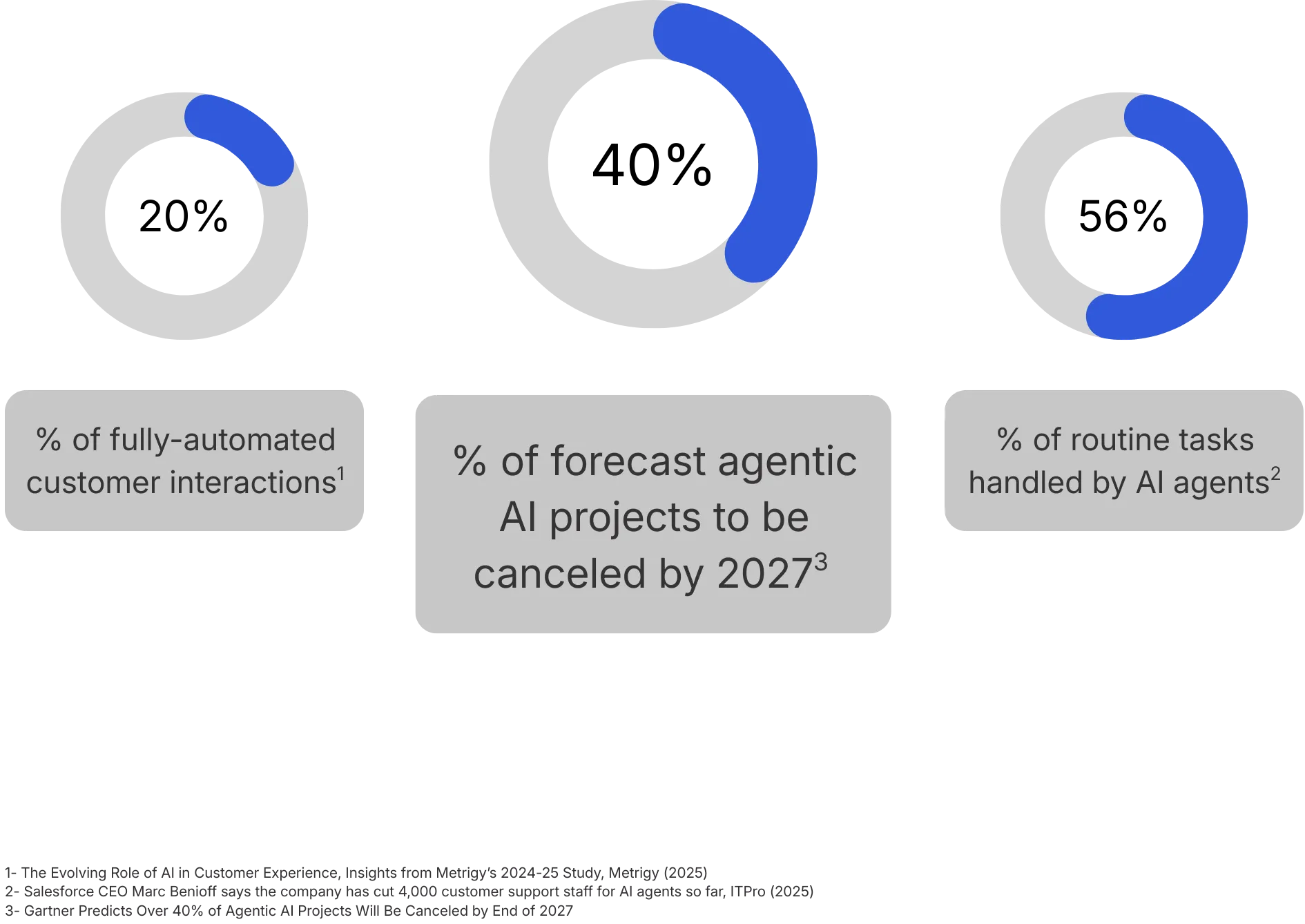
Agentic AI now behaves more like a junior employee than a script. AI is already fully automating around 20% of customer interactions for some organizations, with leaders expecting that share to rise.
In many small and mid-sized contact centers, executives report that AI agents now handle 30–60% of routine tasks, particularly in self-service and low-complexity workflows.
But adoption is still early, and the risk is real.
Gartner forecasts that more than 40% of agentic AI projects will be canceled by the end of 2027 due to escalating costs, unclear business value, or weak risk controls.
In banking, the key question is not just ‘does this work’ but ‘can we explain it.

If AI starts making suggestions without the right data or consent, we can lose trust that took years to build.

That combination of high ambition, high failure risk, and growing complexity shapes the landscape for 2026.
Leaders now have to treat agentic AI as part of the workforce and the operating model, not as a set of point solutions, and they need to set clear expectations for where AI will act independently and where humans must remain in the loop.
What's New in 2026
The reality of AI is much like any process: if all you’re looking to do is automate an old process, one where you know the outcome, all you’ll land on is a faster old process.

CTV buying looks more like digital.
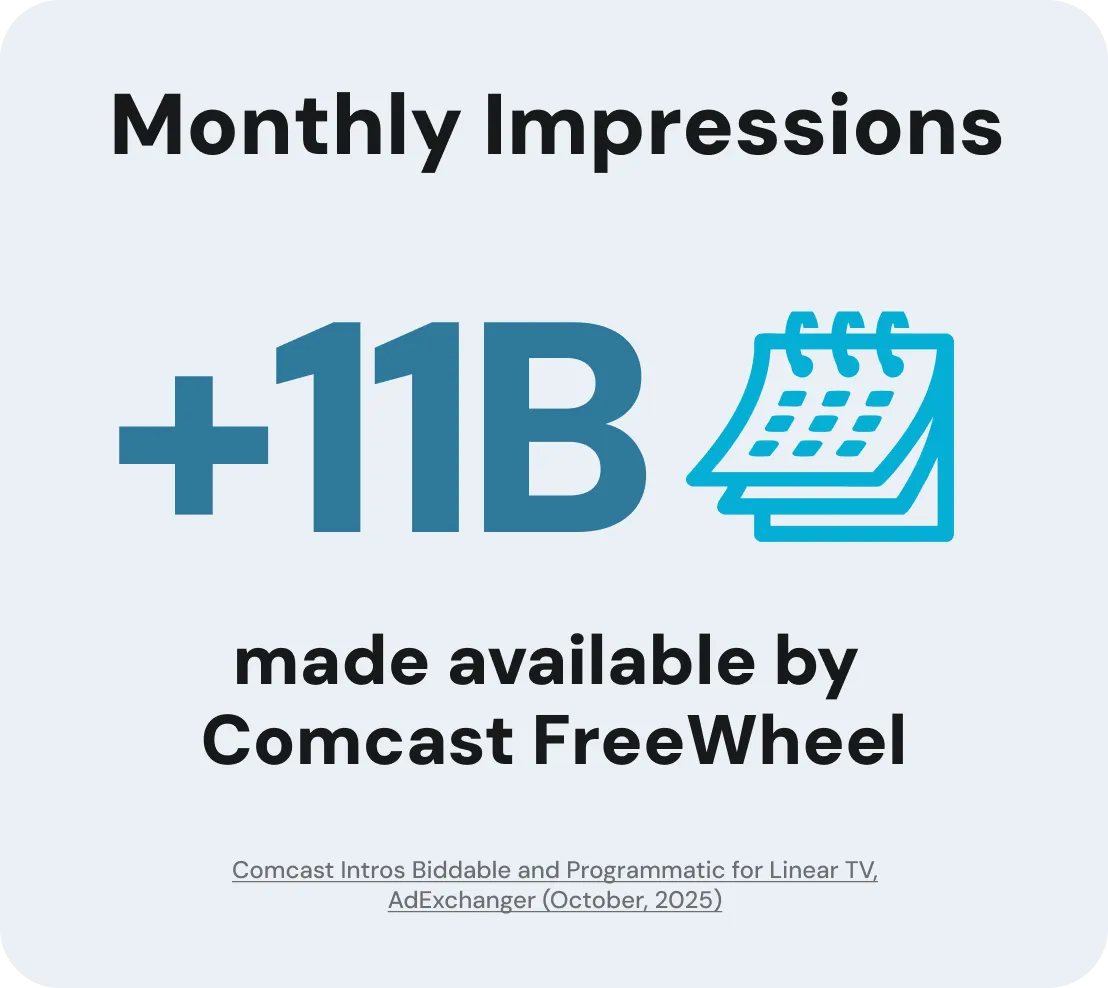
Over the past year, the pipes behind TV and CTV have changed substantially. Large distributors now offer billions of linear impressions through programmatic marketplaces. CTV platforms integrate directly with ad decisioning hubs, giving buyers a clearer line of sight into inventory and delivery than in past TV eras.
- Buyers can access linear and CTV inventory through the same interfaces they use for digital video.
- Deals that once required a series of emails and spreadsheets can now be executed in unified systems.
Planning and buying teams, however, need the same level of transparency, supply-path control, and fraud protection they expect from the rest of their digital media.
AI turns creative into a strategic lever.
AI has quietly removed much of the production friction that once kept advertisers off the big screen. Instead of campaigns rising or falling on a single “hero asset,” teams can now generate, test, and refine dozens of spots around a core idea.
- Cinematic, studio-quality ads can be built with AI likenesses and voiceovers in days instead of weeks or months.
- Tools like Waymark’s CRM integration can generate CTV-ready previews for every prospect in a pipeline using existing brand assets.
The question is no longer whether brands can afford to create for CTV. The question is whether they can define distinctive ideas, maintain quality, and decide which combinations of ideas, audiences, and placements are worth scaling.
Getting the right creative in front of the right person at the right time is still the holy grail of marketing.

CTV often introduces the story, and other channels pick up the thread as people search, click, and eventually buy.

CTV, retail media, and CRM are colliding.
Retail media is already moving from an experiment to a default part of many media plans. As CTV and retail media intersect, especially in environments where ads can be tied directly to purchase behavior, the expectations for what “proof” looks like in TV have shifted.
- Retailers and marketplaces now connect CTV impressions, product detail page views, and sales inside closed-loop systems.
- Some sellers can track how ads in premium environments—like a cooking show on a major streaming service—translate into cart activity and orders on their own platforms.
As more spend flows toward channels that can show closed-loop impact, CTV campaigns that cannot connect to downstream signals will struggle to justify their share of budget.
AI adoption outpaces governance.
Finally, AI adoption has moved faster than the policies and guardrails around it. Many teams are already using AI to draft copy, generate visuals, and assemble storyboards. Fewer have clear standards for when AI is appropriate, when human review is required, and how to disclose AI use in creative workflows.
- AI tools are embedded in creative and media platforms by default.
- Advertisers and agencies are experimenting, but often without shared guidelines.
As AI-assisted creative scales into more markets and campaigns, governance will determine whether it builds brand trust or quietly erodes it.
I see AI as a catalyst—a creative catalyst—but with humans as the real storytellers.

AI + CTV Playbook:
5 Actions for 2026
1
Start every CTV initiative with a measurement plan.
The strongest CTV programs read like any other investment: clear goals, clear metrics, and a clear owner. Treat measurement as part of the creative brief, not a report to write later. Use these steps:
Define a primary objective for each CTV initiative.
For example, incremental revenue, new-to-brand buyers, qualified leads, app installs, or store visits.
Choose concrete metrics and methods.
Combine platform conversions with at least one other lens, such as geo-based tests, retail lift, or brand search volume.
Set thresholds for success before you spend.
Decide what result will justify expansion, what will trigger adjustment, and what will lead you to stop.
Assign clear ownership.
Name a person or team responsible for reading the results and recommending next actions.
2
Treat CTV as a high-attention performance channel.
CTV belongs in the same plan as search, social, and retail media, but it plays a different role. It captures deeper attention and often opens or reinforces the story that other channels finish. Start here:
Map where your audience spends high-attention time.
Think sports, local news, major series, and niche formats.
Decide how viewers can respond.
Use QR code, short URL, store locator, product landing page.
Clarify what you expect CTV to do in the journey.
Decide whether it should introduce the brand, reinforce relevance, or drive immediate response.
Coordinate messaging across channels.
Ensure CTV and other channels build on each other instead of competing.
3
Build an AI-assisted creative engine.
AI should make creative teams faster and smarter, not replace their judgment. The aim is a repeatable system that can generate, test, and scale strong ideas. Follow this pattern:
Define one or two core creative platforms.
For example, “solve one real customer problem per spot” or “show one real local story.”
Use AI to generate first drafts.
Have it propose scripts, voiceovers, and visual options that fit those platforms.
Ask human creative leads to refine outputs.
Have them pick the strongest versions and sharpen them for brand, story, and context.
Produce multiple variations of each core idea.
Change hooks, lengths, CTAs, and tones for different audiences and placements.
Test and log performance.
Track which combinations of idea, audience, and placement outperform the rest, and document them.
Measure reuse of proven patterns over time.
Evaluate how often teams adapt known winners instead of starting from scratch.
4
Connect CTV, CRM, and retail signals into one loop.
CTV becomes more powerful when it is tied directly to known customers and prospects, not just broad demographic targets. Practical steps include:
Sync CRM segments with CTV buying platforms.
Use loyalty tiers and lifecycle stages to inform targeting.
Suppress saturated audiences.
Avoid spending more upper-funnel budget on high-frequency purchasers who do not need it.
Use AI to generate segment-specific creative.
Tailor spots for lapsed buyers, high-value prospects, or other key groups.
Track outcomes by segment across channels.
Compare online, offline, and retail results for each audience.
Feed results back into segmentation and creative.
Update who you target and what you show based on performance.
5
Put simple guardrails around AI-generated creative.
AI-generated creative already appears in high-visibility environments. Clear, lightweight guardrails make AI safer to deploy at scale and easier for teams to use with confidence.
Decide where AI is explicitly allowed in creative.
For example drafts, storyboards, and VO, and where it is off-limits.
Define review steps.
Before any AI-assisted creative goes live on CTV, determine which review steps are required.
Set criteria.
Make ensure AI-generated visuals and copy align with brand voice, cultural context, and legal requirements.
Decide when and how to disclose AI use.
How will you disclose AI use to partners and viewers, if at all?
Track issues or incidents.
Make note of problems related to AI-generated creative and adjust your guidelines.
Connected TV is the media industry’s chance to do what Facebook did for SMBs: make TV advertising hyperlocal and measurable, with real data and tracking behind it. And AI is arriving at the same moment to make the creative faster and easier.

AI + CTV Checklist for 2026
Use the questions below to pressure-test your AI + CTV plans for 2026. If the answer to any is no, that's a clear starting point for change.
Do we define business outcomes and measurement methods for each CTV initiative before we launch?
Do we treat CTV as a high-attention performance channel with a clear role in our funnel?
Do we use AI to accelerate strong creative ideas, not to flood channels with average content?
Can we connect at least one CTV program to CRM and retail data and see its effect on segments that matter?
Do we have written, simple rules for AI use in creative, plus a review process that leaders actually follow?
Do we look at outcomes beyond platform metrics, such as revenue, profit, and brand health?
Is someone clearly accountable for AI + CTV performance across media, creative, and data?
Do we retire underperforming creative and placements based on evidence rather than habit?
Where AI + CTV Go Next
AI and CTV now shape how organizations show up on screens and how they judge success. Most viewers treat streaming as their default TV experience, and advertisers can buy CTV with digital-style control and visibility. Perhaps most importantly, AI has lowered the barrier between a good idea and a big-screen execution. The next phase will be defined less by tools and more by practical choices.
For advertisers, agencies, and media sellers, the opportunity is to deliberately design AI + CTV programs that advance real goals: profitable growth, compelling storytelling, and durable customer relationships. The leaders who move now—clarifying measurement, creative, data connections, and governance—will be in the best position to build brands that perform on every screen.
Signals from the Field
The power is thinking of CTV like social. If an ad misses, you just run a different one.

Creative used to be one-to-many. With AI, it becomes one-to-one: Different commercials for different people. Still on brand, but tailored.

When every big title is exclusive to a single platform, and users have limited budgets, churn rises.

If creative friction is no longer the barrier to spinning up connected TV, the next big challenge is measurement.

Think about measurement first—how we're going to measure it, what our KPI is, what hypothesis we're testing.

CTV plus AI-driven dynamic creative is becoming a way to bring some order back into holiday and seasonal campaigns.

Methodology
This editorial report draws on a mix of real-world insights and industry data to reflect a reality already visible to advertisers, sellers, and viewers.
First, we conducted interviews with experts and practitioners, including programmatic and supply-path leaders, measurement and attribution specialists, streaming and broadcast sales leaders, and AI and marketing strategists advising brands on adopting generative and agentic AI. These conversations also inform standalone feature stories in trade publications.
Second, we analyzed recent Waymark research and coverage on streaming, CTV, and AI-driven creative and measurement, focusing on consumer behavior in streaming and FAST channels, the evolution of CTV buying rails and unified marketplaces, the intersection of retail media, closed-loop attribution, and CTV, and the adoption of AI in creative and media workflows.
Finally, the editorial team compared themes across interview transcripts and data findings to identify patterns in how AI and CTV are being used, where they create value, and where they create risk. The result is a 360-degree snapshot of AI + CTV from 2025 to 2026 and a practical playbook for advertisers and media leaders planning their next moves.
