
Growth Teams Don’t Need More Brand Rules. They Need Brand Systems.
Dmitry Shamis, Co-Founder of OhSNAP! and former HubSpot Global Head of Creative, on why brand systems beat brand documents and unlock the team to take the big swings in unison.
Make Ad World News one of your go-to sources on Google


"For a brand to be usable, it needs to be accessible, understandable, and actionable. Otherwise it's just a set of rules that creatives can follow and everyone else is afraid to touch."

Dmitry Shamis
Marketing teams at growth-stage companies routinely outnumber their creative teams 10 to 1. A request for a one-page sponsorship flyer enters a triage queue on Monday and sits there for weeks while the in-house creative agency works through a launch landing page and a stage deck for the founder. The flyer ships in a state nobody is proud of, or it never ships at all. The brand becomes the rate-limiter for the work it was built to enable. The way out is to treat the brand as software that the rest of the org can run.
Dmitry Shamis is the Co-Founder of OhSNAP!, a brand systems agency he started with his former HubSpot head of design, Jenn Webb-Proud. Before that, he spent years as Global Head of Creative at HubSpot, where he scaled an in-house creative agency from 30 to 155 people across three continents on a $20 million annual budget. One of his early experiments at HubSpot produced 30,000 web pages across six languages, none of which a developer ever touched, by giving marketers a self-service mechanism to build them. His argument is that a brand stops being an asset the moment everyone outside the design team is afraid to use it.
"For a brand to be usable, it needs to be accessible, understandable, and actionable. Otherwise it's just a set of rules that creatives can follow and everyone else is afraid to touch," Shamis says.
The brand most companies wrote was meant for someone else
Most brand guidelines are written by creatives for creatives. The foundational design systems inside Figma serve the design team exactly as they should, documenting components at the precision a professional designer needs. Move that same file one floor up to the marketing team, and a request for a flyer turns into a request for a designer's calendar.
"Oftentimes, when a brand gets built, it gets built specifically for the creatives, and that's where you see these wild rules about dos and don'ts. The logo has to be in this shape only with this much padding," Shamis says. "I'm not a designer. If I'm using a tool, whether it's Photoshop, Canva, or Figma, I don't know how to do all that stuff. That is a scary thing to me. I don't want to be the one who destroys the brand. I'm going to put the wrong logo on, and that's it, the company is going to crumble."
Visual identity is where the gap turns into a canyon. Words travel; a list of hex codes does not. "The brand strategy is for everyone, but the visual identity? I don't know what you want me to do with just a list of hex colors. Does this blue go with this red, or should I use this pink version? There's shading. It's crazy. All of those things are for the creatives." The moment non-designers cannot move without a designer, every routine asset joins the same queue as the heavy creative work. The brand becomes a tax on speed.
A usable brand ships like a Lego set
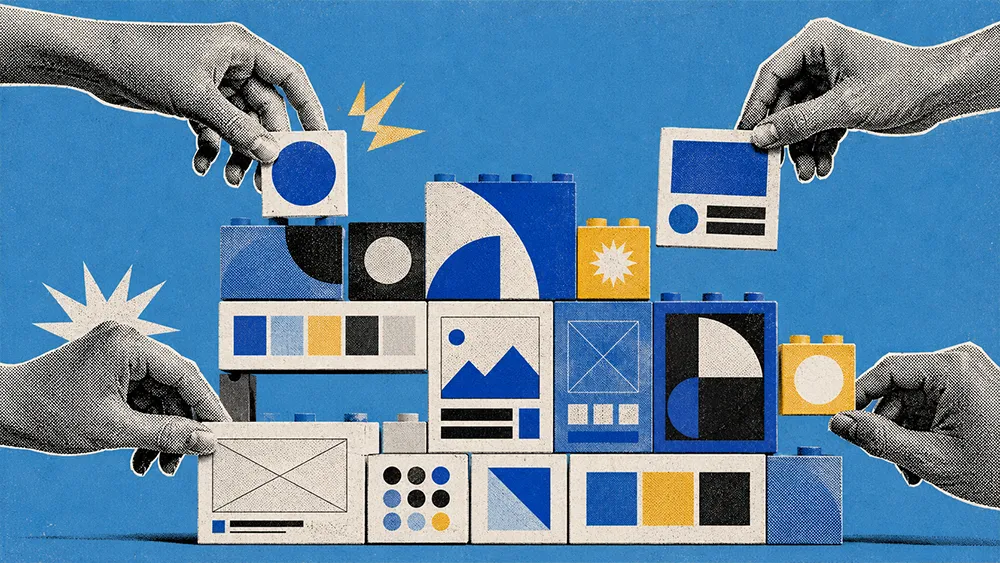
Shamis builds modular, self-service systems across the marketing tech stack, an approach he compares to Nintendo Lego sets. Mario Land and Bowser's Castle each work independently and snap together into a single, cohesive ecosystem when a company is ready to assemble more of it. In practice, that translates to video tools like Capsule with prebuilt lower-thirds and end-card templates, a CMS with drag-and-drop modular page sections so marketers can assemble web pages without wireframes, and digital asset management platforms like Air so teams can find current logos and illustrations instead of mining shared drives for the latest version.
At HubSpot, that thinking extended into design tooling itself. Shamis and his now-business partner signed the very first Canva Enterprise agreement, giving marketers a way to autonomously generate hundreds of on-brand designs every week. The software was a means, never the whole solution. "We can invest in Canva licenses for everyone," Shamis says, but without proper onboarding, employees are left wondering why they need the tool and how it will help them do their jobs. "The education is actually just as important as the build-out of the tools." Software without onboarding is just another tab in someone's browser. The teams getting value from these tools are the ones whose questions are answered before they get stuck.
The internal experience becomes the external one
When the asset is not there, someone makes do. A salesperson rebuilds a deck from memory. An events lead pulls a logo off the website. Each improvisation ships, and the customer assembles the brand from whichever version reached them first.
"If you think about the process: you submit a request, which gets triaged. You kick off a week later. You have to collect requirements. The current sprint and the next sprint are full. Now we're not getting started for another four weeks. We've got multiple review and feedback rounds," Shamis explains. "Suddenly, this thing that seemed like a tiny lift has taken two months to get done. When you're moving at that pace, you are essentially bottlenecking what goes out into the world."
Customers assemble a brand from every fragment they encounter, and inconsistency erodes the trust the brand has spent years building. "When you see a social post or an ad, and it's blue, and then you get to the website, and it's green, and then you decide to sign up for the product, and it's orange," Shamis says, customers can start to question if they are even dealing with the same company. The reader sees fragmentation and calls it carelessness. The brand that meant well gets remembered as the one that did not bother.
The big swings depend on building the bottom of the grid first
Shamis's response to that pattern is a 2x2 Scaling Creative Framework. The vertical axis sorts work by type, with "creative-led" projects at the top, the brand-new initiatives that lack playbooks, and "creative-supported" work at the bottom, the repeatable run-rate output that ships every day. The horizontal axis sorts by where the work happens, with internal teams on one side and external vendors on the other. Most corporate creative work sits in the bottom half of the grid as creative-supported, run-rate output, such as landing pages and ad resizes. The top half holds the big swings.
Self-service systems like Canva, Capsule, modular CMSs, and Air occupy the bottom-right quadrant, where non-designers can manage repeatable tasks themselves. Advanced work that isn't a good use of in-house time moves to trusted freelancers and vendors in the bottom-left. Building out the bottom of the grid first frees the in-house team from low-leverage busywork and creates the headroom for the top half to exist.
"The reason why setting up the bottom of this grid is so important is because it frees up the in-house team for these big swings," Shamis says. "When teams are stuck just in busy work, the creative teams are not able to take chances. They're not able to do things that might 10x the business. The joke is always the Super Bowl, but you're never making a Super Bowl ad if you can't actually stop to focus on what that Super Bowl ad should be."
The framework runs as a flywheel over time. Big-swing work that lands gets codified into playbooks and templates and pushed down into the self-service layer, where the next round of marketers can run it themselves. Yesterday's big swing becomes today's template, and the creative team gets back the time to take tomorrow's.
AI is only as on-brand as the system feeding it
Shamis treats AI the way he treats Canva, as a production tool for run-rate work that needs a brand system underneath it to be worth anything. Because AI aggregates patterns from everything it has ingested, output produced without clear brand guardrails drifts toward a generic design that blends into the market. Other operators have landed on the same split, with AI handling the copilot and pattern-surfacing roles, while humans still own the work audiences see.
Many teams approach AI looking for a quick ad or web page design without any broader system in place. "AI, as we know, is just a collection of thoughts," Shamis says. "I saw something on LinkedIn last night where it said AI design is design by committee. All of the stuff that is produced, while yes, it looks good, is it on brand? No. Is it going to convert? Probably not. Is it going to look like everything else on the market? Without a doubt."
The companies seeing AI pay off are the ones who put the brand system in place before the model showed up. Once a brand can connect Canva directly to a generative tool like Claude, templates built for scale become the input layer for AI-generated variants that still look like the brand. Consistency turns AI into leverage. Differentiation remains a human problem, the kind of work that requires the cultural judgment AI cannot manufacture and the cognitive rhythm that AI tends to flatten out of a team's week.
Shamis traces the failure pattern back to its origin point, brand work that gets handed off as a static deliverable and dies there. "I think the idea that you could email someone a PDF and just disappear is nonsense," he says. "That's what ends up happening, and that's where the idea of brand not working or not being usable comes from. You're a CMO or CEO, you just spent hundreds of thousands of dollars and invested so many hours of time, and then someone emails you a PDF, no one knows what to do with it, and it just collects dust in Google Drive. That's unacceptable."
A brand that cannot be operated is not a brand
A brand built as infrastructure lets every team in the company ship at their own pace. A brand built as a document waits in someone's downloads folder while a junior marketer rebuilds the logo in PowerPoint and the flyer ships looking like it came from a competitor. Agentic AI and conversational discovery are about to handle most of the brand impressions a customer ever forms. The companies that built the system will scale through that. The companies that emailed the PDF will not.