
General Mills' Marketing Legacy Points AI-Era Marketers At The Consumer Question First
Natasha Bruns, Senior Corporate Archivist at General Mills, shares why the same consumer-first marketing principle has held across every era of the company's brand portfolio.
Make Ad World News one of your go-to sources on Google


The platforms were different, but the principle was the same as it is today. Consumers are looking for brands that listen, respond, and provide value. In many ways, Betty Crocker was one of the first true influencers.

Natasha Bruns
Long before social listening had a name, American consumer brands were doing it by hand. Households sent in cooking questions, product complaints, and household problems, and the brand personalities built to answer them became some of the most durable assets in American marketing history. Those brands built trusted household resources using the fastest tools available to them at the time, and the model they invented is the one AI-era marketers are still working from.
Natasha Bruns, Senior Corporate Archivist at General Mills, works inside the historical record of some of the most recognizable brands in American marketing. Her background is in building digital exhibits at the University of Minnesota Libraries, and she now manages the archives that document the campaign, product, and consumer engagement history of brands like Betty Crocker, Wheaties, and Cheerios. From that vantage point, Bruns sees a set of consumer engagement principles that have held remarkably steady across the last century, even as the channels carrying them have completely reinvented themselves.
"The platforms were different, but the principle was the same as it is today. Consumers are looking for brands that listen, respond, and provide value. In many ways, Betty Crocker was one of the first true influencers," says Bruns. The listen-and-respond principle was showing up in General Mills' product decisions before it showed up in the marketing. The company's earliest release, Gold Medal Flour, drew a direct line from consumer aspiration to brand identity through the emotional payoff of victory. Bisquick expanded that approach in 1931 by arriving as a practical answer to the daily burden of Depression-era home cooking, starting a pattern that holds across every era of the portfolio.
Reading the room across eras
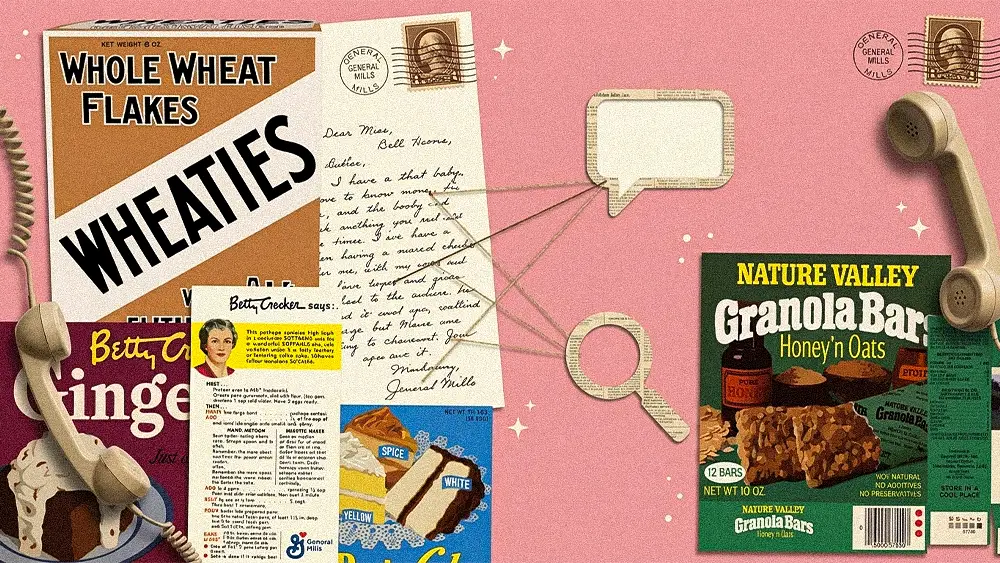
Emotional storytelling only scales when a company has an organized system for hearing consumers first. General Mills built that system in the 1920s through the Home Service Department, a team of women trained in home economics and nutrition who responded directly to consumer letters. The correspondence became a durable listening infrastructure that helped the brand maintain credibility through decades of national hardship, including a WWII pivot where the team reframed its advice around helping working women manage rations without losing nutrition. "Our archives contain decades of consumer letters and Home Service correspondence that document how closely the Betty Crocker team listened to changing consumer needs," Bruns explains. "No one would have used the term 'social listening' at the time, but the practice was similar."
The same listening discipline runs through General Mills' modern brand activations, where the input signal has moved from letters to online conversation without changing what the company does with it. Gushers picked up on internet nostalgia around a widely remembered nineties campaign and released a horror-film revival of the Fruitheads commercial as a Halloween tie-in. Progresso built on cultural conversations around barbecue and product humor by launching Pitmaster Deodorant as a limited-edition companion to a new product line. In both cases, the trigger is consumer signal picked up in real time and translated into product-adjacent storytelling that lands as insider knowledge.
Growing up with the consumer
General Mills was running life-stage personalization decades before the term existed. Cheerios is the clearest example, evolving from a baby's first finger food into a staple that carries across generations, most recently through a limited-edition "Honey Nuts For You" ring collection that leaned into the blind-box cultural moment for a different audience segment entirely. The mechanism is old, but the operating principle behind it is what modern marketers would call earned trust. "By providing timely, useful information that fit their everyday lives, these early touchpoints made consumers feel seen," says Bruns. "The ultimate goal was to become a trusted resource, moving beyond just selling a product."
The same principle extends into lifestyle-adjacent territory when the product's utility connects to an identity the consumer is already building. Nature Valley leaned into that connection with the launch of the first granola bar in 1973, and later partnered with the National Park Foundation to fund conservation work that reinforced the outdoor identity its consumers self-selected into. Wheaties has followed a parallel track around athletic aspiration for nearly a century, running its Champion program from the 1930s through today's box featuring A'ja Wilson that pulls the same aspirational lever across a new generation of sports fans.
Brand IP itself becomes a lifetime asset when the character or personality earns durable consumer recognition, which is why the Pillsbury Doughboy still delivers marketing value more than six decades after his debut. Nine out of ten consumers recognized him within two years of his introduction, and General Mills has continued to translate that equity into new formats, most recently by opening his home to fans through an AR experience for his 60th birthday. What connects the past and present is the same underlying calculation: whatever format the brand borrows, it has to give consumers something they can actually use. "Successful marketing focused on the value to the consumer," Bruns notes. "Consumers have been, and continue to be, more likely to trust brands that make their lives easier, teach them something new or help them solve a problem."
Cues from the archives
The patterns the General Mills archives reveal are what make them useful today. As conversations around AI's impact on brand trust intensify across the industry, the company continues to reach for the same operating principle that carried Betty Crocker from signed letters into radio, television, and the current network of third-party Betty Makers influencers running the recipe economy on social platforms. Whatever channel the brand adds next, Bruns says the analytical question underneath the decision has stayed constant: 'What does the consumer actually need from us in this format, and how do we deliver it in a way they can use?'
Bruns reads the current AI moment as part of that same recurring cycle. What she watches for is whether marketers can hold their focus on the consumer relationship long enough for the AI conversation to settle into something operational. "Every major shift from radio to television to the internet generated excitement around the technology, but the brands that endured were the ones that used those platforms to strengthen relationships," she concludes.