
AI provides the speed, but people provide the soul. You still need experts to guide the tools, because an algorithm will never truly understand your user as well as you do
 Harry LangFounder @ Bax Media
AI coding tools are collapsing the distance between product idea and production, but they are not removing the need for product leadership. A single operator can now stand up a complex, revenue-generating app in weeks, extending to multiple platforms with advanced features that once required full teams. The real shift is how the work gets done: treating AI agents like a structured team with clear requirements, constant oversight, and iterative refinement. Speed has improved dramatically, but success still hinges on judgment, context, and control over the system being built.
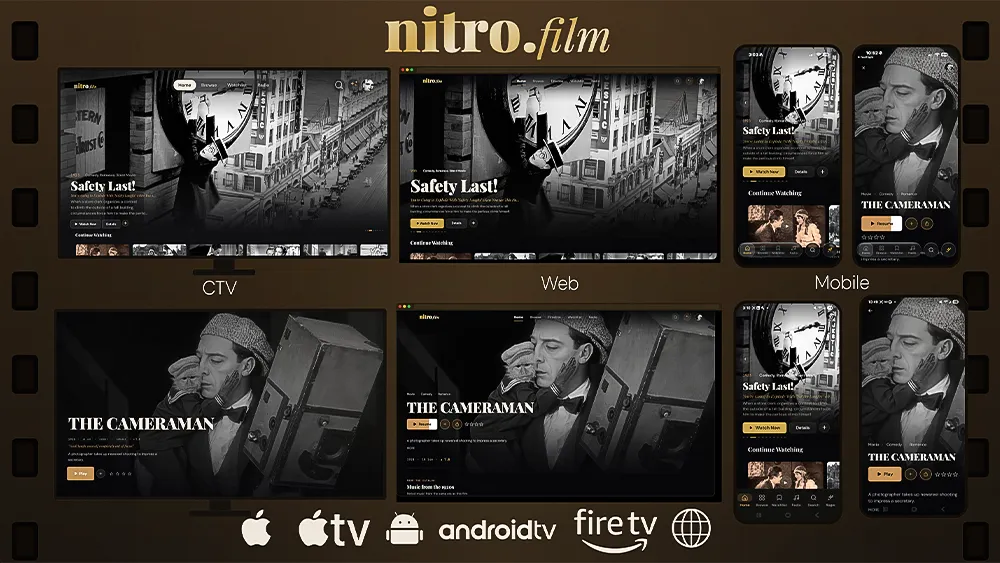
Not long ago, this would have been impossible. Harry Lang, Founder of Bax Media, built and launched Nitro.Film in roughly two months, a multi-platform streaming service spanning Web, iOS, Apple TV, Android, Android TV and Fire TV, with diagnostics, multi-regional CDNs, watch-time analytics, and AI-driven recommendations built in. His 15 years in streaming explain the pace. As former VP of Product Management at Pluto TV, he helped scale the platform past 80 million monthly active users across 50 platforms and 35 countries, contributing to more than $1 billion in annual revenue. Earlier at Hallmark Media, he led Product for their SVOD and drove a 40x subscriber increase. For Lang, his recent solo project is less a story about AI building an app overnight and more about what an experienced streaming executive can do when AI becomes part of the standard product toolkit.
"AI provides the speed, but people provide the soul. You still need experts to guide the tools, because an algorithm will never truly understand your user as well as you do," Lang shares. As he continues building, he is structuring his workflow by treating AI agents much like a scrum team. He isn’t writing the code himself. Instead, he supplies detailed requirements, acceptance criteria, and design intent, then reviews the output against those expectations. Applying a product-management mindset, where specifying what success looks like and insisting on iterative refinement shapes every step of the build.
The new scrum: Lang's extensive product management experience is what he leans on to build so quickly. "As a product manager, I'm not writing code. I'm providing engineers requirements and acceptance criteria. It's the same process, only now my team are agents instead of designers and engineers and QA," he shares. The reason he leans into the PM role is because working with AI, in its current, still involves a lot of hand holding. "AI often says, 'Here it is. I'm done!' But AI doesn't remove the need for leadership, it shifts the role to one of rigorous quality control. When an agent misses a requirement, the human expert must be there to identify the gap and guide it toward the correct solution."
Like many developers, Lang is finding that while these tools are often great at proposing quick local fixes, they struggle to grasp the wider implications across a large, interconnected codebase. In some sessions, an agent might suggest refactoring the entire authentication flow to solve a small login bug. Because his Pluto TV experience taught him how multi-platform dependencies interact, he could see those risks in real time and reject changes that would have created massive headaches across his live platforms. Without his specific domain expertise, the AI could have easily driven the project off a cliff.
Active oversight: Lang makes the point that developing comprehensive app infrastructure as quickly as he did is still quite difficult without pointed expertise. "Everything it does, I have to watch. It's not set it and let it build overnight. I do not trust it enough to build on its own," he says, adding that the system without proper oversight remains relatively fragile. "AI doesn't naturally see the 'big picture.' It might solve the problem right in front of it, but because it doesn't always remember the full history of the build, it lacks situational awareness. You have to be the glue that holds the context together, or one small fix could break another platform."
The un-fireable intern: Lang is also solving for the fact that agents lose context after a while, forcing him to repeatedly start fresh. His answer is a self-maintaining documentation system. He creates requirement documents, architecture diagrams, and feature notes that the agents has to update as they ship new work. Each new session begins by reading those materials, mimicking how an engineering lead would onboard a new hire. "Every new agent is like onboarding a new engineer," Lang says. "And that happens multiple times a day because they run out of context. They start hallucinating. It will make so many junior level mistakes that you would think that it's an intern. It tests your patience, but you can't put it on a performance improvement plan. So you just have to make sure you provide it with the context."
Zooming out to the media business at large, Lang is careful to draw a line between what one person can do with AI and what a large organization should attempt. Compliance and security processes at major media companies often make it difficult to iterate as quickly as a founder working on their own project. Still, he believes the main impact of AI for those cases is highly practical: it means faster prototyping, quicker tests, and more efficient triage, rather than wholesale staff cuts.
Need for speed: "The way you've done typical discovery and prototyping and user testing, AI is going to greatly improve the speed to those testing cycles and those results," Lang says. But he notes that the tool can not replace the expertise specialists bring to the equation. "AI is augmenting your existing teams, so you still need those teams who are the experts in their field, and fully understand the user and the service itself."
AI, he says, allows founders to focus on curation and quality control within their domain rather than being responsible for the full build. Many industry veterans note that engineers generally still need to understand code and system architecture well enough to review what an agent produces. Designers are still relied upon to recognize good, human-centered interfaces and flows. For product managers, the core responsibility remains understanding exactly who the user is and what they expect from a given service.
Staying in your lane: For people looking to build in a similar fashion, Lang suggests creating an app within the industry founders know best. For him, that was streaming. "A user of Netflix may be different than a user of Hallmark, but I wouldn't have attempted this with a banking app because that's not my expertise. I don't understand what it takes to build something like that."
His recent solo build ultimately reinforces a straightforward product management playbook for working with AI: provide rigorous context, understand the end-to-end flow of the service, know what users expect, and stay close enough to the work to intervene when the tools go off track. His process was less about chasing a novelty build and more about applying familiar enterprise practices to a new kind of collaborator.
For others looking to follow in his footsteps, Lang offers a grounded piece of advice. Rather than worrying about shipping a massive commercial project, he suggests starting small and focusing on the sheer utility of the tools. "I started just by building some simple websites and getting familiar with it. Whether it's Claude Code, which is what I used for my service, or Gemini, OpenAI. Just start building and start learning, and as you do it more, you'll start to take bigger chances and try to really see what you can do." He assures you the results will be well worth it: "There is something uniquely rewarding about the agency AI gives you. It’s incredibly powerful to build your own product from scratch and finally watch a real audience hit play."