
CTV Is Catching Up To Performance Marketing, One Remote Click At A Time
Olivier Karra, Cloud Solutions Marketing Director at Broadpeak, explains how a single click of the remote could open up an entirely new era for CTV advertising.
Make Ad World News one of your go-to sources on Google


Today, traditional advertising on streaming and CTV is all about impressions. The challenge for everyone is that you never know whether someone is actually watching an ad or not.

Olivier Karra
Performance ad budgets are climbing across paid search, social media, and native web platforms while linear TV advertising plateaus. Streaming platforms stand to gain a massive share of premium video inventory as a result, but most performance-focused advertisers' CTV strategies are behind the times. Despite its untapped measurement potential, CTV still leans heavily on passive, impression-based tracking rather than the actionable, verifiable clicks that drive performance campaigns on the web.
Olivier Karra, Cloud Solutions Marketing Director at Broadpeak, a video delivery technology company that powers streaming infrastructure for major content providers and network operators worldwide, is building the infrastructure to close that gap. With two decades of experience architecting video delivery networks, including a tenure as Senior Director of IP Video at Nokia and ongoing work as a visiting lecturer at Télécom Paris, he sees a clear opportunity to update the monetization playbook for the living room. "Today, traditional advertising on streaming and CTV is all about impressions," Karra says. "The challenge for everyone is that you never know whether someone is actually watching an ad or not."
Translating trackable web conversions to a connected television format boils down to solving a simple hardware problem. Digital marketers are used to optimizing campaigns around immediate, measurable actions like a click, a purchase, or sign-up, which is well-represented in examples like travel ads on social platforms or the recent rollout of automated CRM activation tools. Bringing that same feedback loop to CTV means finding ways to support comparable click-like signals across all streaming inventory. That's the exact problem Karra is working on.
The MIA mouse: "In performance advertising on the web, you click on a banner or a pop-up, and that translates into all the KPIs being logged and bidding happening across the stack," Karra shares. "That is the number one thing. It is about building the tech stack to enable that kind of event in a CTV environment. Right now, there is no mouse, there is no clickable ad so far."
Several major streaming platforms are rethinking how TV interfaces work. The industry is seeing leadership changes tied to product overhauls, the addition of TikTok-style vertical feeds, and the adoption of AI-driven personalization engines. Because many viewers express skepticism toward disruptive ad formats, developers are looking for ways to capture intent without ruining the viewing experience. Instead of forcing heavy lifting on the TV itself, newer solutions route the transaction directly to the user's mobile device.
Ghosts of T-commerce past: "A number of years ago, some publishers tried to build micro e-commerce websites on the CTV, and it was a complete failure," Karra says. "People are not willing to browse and search on their TV. They just want to watch content." The problem, he explains, lies in building an experience that feels truly native to the CTV platform.
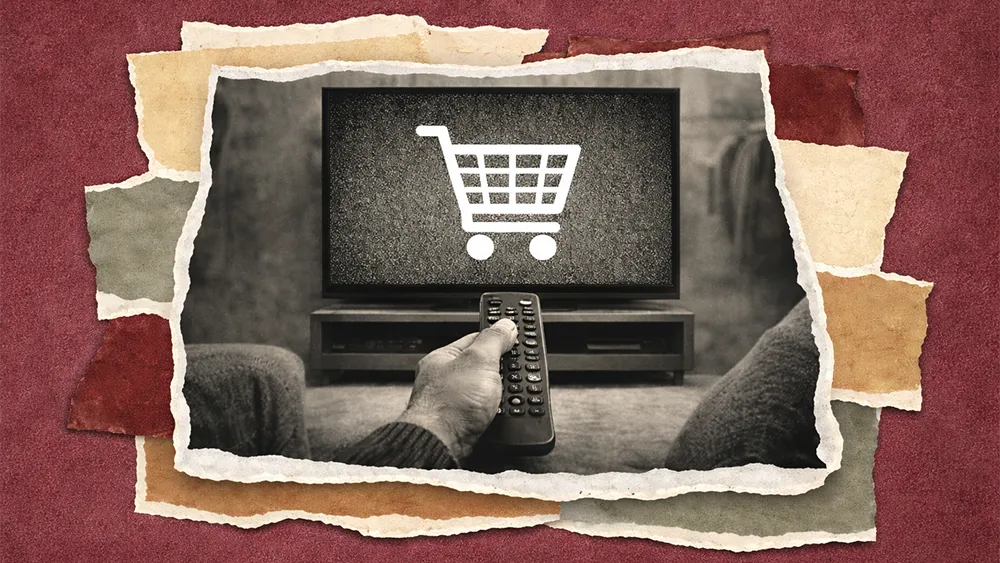
Clicking the clicker: To translate intent into clear measurement, Karra and his team have come up with an easy but effective solution. "The idea is really to offer the user the simplest call-to-action to initiate that workflow, and the simplest method we thought about is clicking the remote control," he says. "That is the trigger. If a user is interested in a product, that is all it takes to register that intention." In other words, a single button press on the remote acts as the TV equivalent of clicking an ad online. The click signals interest, logs the action, and initiates an offer, or a checkout page sent directly to the viewer's phone.
Brand marketers frequently face fragmentation across different platforms. Unified, shoppable formats offer a way to make campaigns more consistent by borrowing the business logic that already works on the web. Some of the largest platforms already demonstrate how a "remote-to-phone" pipeline can work at scale. On YouTube, viewers can trigger a “send to phone” prompt that moves the journey to a linked mobile device. Roku’s Action Ads let users press "OK" on the remote to receive a follow-up text message, while its Shopify integration brings native checkout elements into the TV ecosystem.
The second screen: "If you watch YouTube on your CTV, you will see shoppable ads with a send-to-phone call-to-action button," Karra says. "If your phone is linked to your CTV, you will experience exactly what we are talking about. This is performance advertising, and it is getting big."
The next challenge lies in making the path from TV screen to checkout as short as possible. Samsung recently pitched full-funnel CTV ad products featuring "add to cart" options, and Walmart launched a fully shoppable video series across platforms like Roku and YouTube. Broadpeak plans to unveil its own "Click to Cart" feature at the upcoming NAB show, treating the remote control as a direct pipeline to the mobile shopping cart. The model caters directly to the dual-screen habits of younger audiences, allowing them to shop without interrupting their content.
Couch to cart: "For use cases where the publisher has partnerships with retail platforms, when a user clicks their remote control to signal they like a product on their CTV, that product is instantly placed in the cart on their smartphone app," Karra says. "Then you are one click away from buying that product on your phone."
As technology evolves and audiences grow accustomed to more connected experiences, solving this problem becomes an imperative for ad technology. "A Gen Z viewer may be doing both things at the same time, watching content on the CTV and browsing e-commerce on their smartphone," Karra highlights. "It is becoming the norm for certain generations and audiences, so we definitely have to move in that direction."