
AI is Rewiring Campaigns in Real Time, Replacing Big Bets with Constant Iteration
David Gidali, Director and VFX Supervisor at Dinoboy VFX, explains that AI is most powerful when used to rapidly explore and refine ideas, with the creator guiding the process to shape outcomes that the tools alone cannot define.
Make Ad World News one of your go-to sources on Google


We are entering a phase where creative work is no longer constrained by production limits, but by how well you can direct and refine what the tools generate.

David Gidali
AI has rapidly expanded what’s possible across budget tiers in visual effects and commercial production. Work that once took months can now be done in weeks, often at lower cost, while clients expect more ambitious results for the same spend. This marks a deeper shift as creative production is moving from a linear process to a scalable, iterative system. In this model, ideas can be generated, tested, and refined in parallel, and where the advantage comes from how well you direct and shape what AI produces.
David Gidali is a Director and VFX Supervisor at Dinoboy VFX, a Los Angeles-based studio specializing in premium narrative content. His work spans full-length theatrical films and short-form branded content for global networks. FACE SWAP, the world’s first narrative deepfake short film, and the disaster thriller 10.0 Earthquake are among the projects he has directed and produced. Operating at the intersection of commercial VFX and original filmmaking, Gidali tests these tools under real production pressure on both sides of the business.
"We are entering a phase where creative work is no longer constrained by production limits, but by how well you can direct and refine what the tools generate," Gidali says. Achieving that level of control meant figuring out how to let AI work alongside his process.
Cracking the code: "Moving to Cursor allows AI to read, write, and see what I'm working on as I develop it. The AI doesn’t see my screenwriting app, so it can’t track changes automatically or edit inside the final draft, which would otherwise make me to copy and paste constantly," he explains. With the tooling solved, the next question was what to feed it. "That was a big unlock. Starting with an existing piece of literature with depth let the AI hone in on the voice, tone, and overall story. It's not a situation where I ask the AI to help me come up with a script, give it a sentence, and have it fill in the rest." That context sharpens the output, but the model still has blind spots.
Productive friction: "I would say it's a genius savant. It doesn't always understand people's motivations and psychological nuance, and its suggestions come from literature and its training. But its word choices and sentence structure inspires me. It's great for screenwriting because it helps get to the point quickly, and correcting it often sparks new ideas," Gidali adds. That faster ideation cycle is already changing clients' demands. "Things previously unattainable on lower budgets are now possible with AI. Clients ask for bigger results for less, and expectations have risen over the last four months with the new models." Rising expectations on projects are only part of the change, the bigger shift is in volume.
Output unleashed: "We're not far from campaigns splitting into more testing and variations. You'll see many more versions of campaigns at once because it's so cheap to generate one piece of advertising. You could send out a campaign with 10 or 100 times the media we used to," Gidali notes. That capacity is spilling into original work. "The content side always went into the backseat because marketing paid the bills. But now things are faster, and I have more time to experiment." He recently completed an AI-powered short film in two weeks, a project that would have taken six months before. "Being able to generate original content at that cadence while still working full time wasn't possible before AI." That short film also shaped how he handles AI's visual flaws.
"My approach to generating videos with AI is to lean into the AI's aesthetic," he says. Embracing AI's imperfections requires careful creative judgment. "I’m actually referring to the mistakes: the awkwardness, bad acting, the weird. In a way, I’m the client for those mistakes. Documentaries often combine different media in an engaging way: fast-cut sound bites, images layered together. That works well for the limitations I have with AI." While embracing AI’s quirks can enhance creativity, technology alone doesn’t determine how work is received.
The complacency trap: "Public opinion about VFX has shifted from awe to rejection. 'Oh, it's all made by computers. We miss the old ways of making films.' The distinction is not the technology, but how it's used," Gidali outlines. He points to one film where balance held. "Not a lot of people look at Jurassic Park and say, 'Oh, I hate CGI.' It's used only where necessary, alongside animatronics, puppets, and humans in costumes." Yet issues appear when reliance on technology replaces intentional decisions. "Filmmakers have grown complacent, leaving creative decisions to the editing room,” he warns. “Scenes are bland, lacking intent. People are leaning back, letting technology take ownership." That same passivity shows up in how clients brief VFX work.
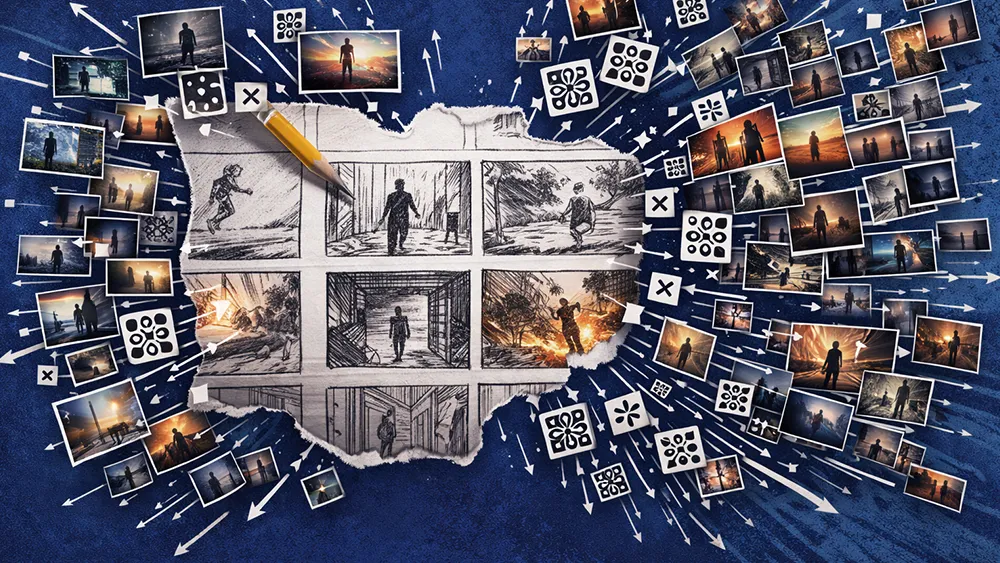
Designs in lockstep: "Storyboards used to be sketches, black ink on white paper, abstract enough to let me create a look that fits the budget. Now, people are replacing them with polished AI-generated renders. The storyboard becomes a goalpost. Recreating the final picture saves time but robs creativity and flexibility," Gidali emphasizes. "Sometimes I feel like I start collaborating with AI too early and don’t let the story simmer. I can see a future where AI is so good I just sit back and let it pitch ideas while I clap." Even with AI pitching ideas, real-world challenges still require hands-on decisions.
Name the star: "During FACE SWAP, which used deepfakes of famous actors, I realized not everyone would recognize George Clooney and Rachel McAdams,” he explains. "About 5–10% of people have prosopagnosia, or face blindness, so I added a cue, having their names said aloud, even though the faces are visible. It's my job as a creator to understand the audience in order to try to do my best to make this film cater to the biggest audience possible." Even with these practical considerations, the tools are only as powerful as the guidance shaping them.
AI expands what’s possible, but thoughtful direction remains essential. From storyboards to visual effects, the technology enhances ideas without replacing the creator’s judgment. It amplifies imagination, letting creators explore faster while staying in control of the vision. "AI complements me but doesn’t silence me. It doesn’t make me doubt my ideas. Down the line, steering the ship might slow the AI, but I enjoy the process," Gidali concludes.