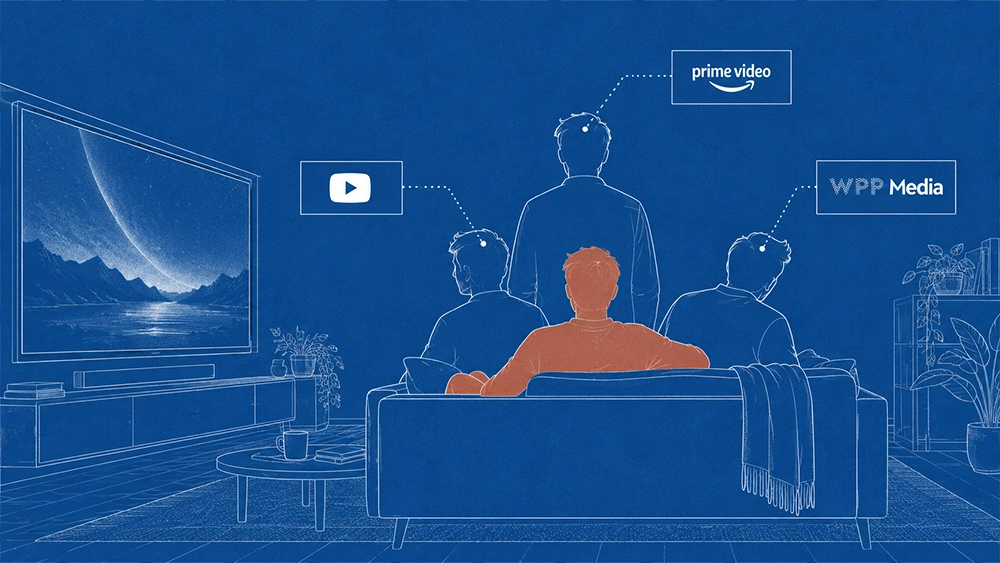

The most powerful metric in advertising is the impression. There's no way more powerful than CTV to get that impression across. It's full screen and you get time to tell a story through video.
 David NyurenbergSVP of Digital @ InterMedia Advertising
Performance marketers are bringing a click-based mindset into a channel that doesn’t behave like one. As direct-to-consumer brands push budget into streaming to escape rising costs on Google and Meta, many expect the same fast, deterministic feedback they get from search and social. Instead, they run into a system built around reach, memory, and delayed action. Platforms like Vibe, MNTN, and TV Scientific make CTV more accessible, but they don’t change how it works. Treat it like a performance channel, and it will appear to miss the mark.
David Nyurenberg, SVP of Digital at InterMedia Advertising and a 2025 AdExchanger Rising Star, understands the plumbing on both sides of the equation. Before scaling a Fortune 500 advertiser’s monthly CTV spend from $300,000 to more than $1.3 million, he founded Valor, a data engineering consultancy. That mix of media-buying experience and data expertise gives him a practical view into how streaming is actually bought, measured, and optimized. Nyurenberg says that many frustrations with CTV trace back to how buyers value impressions, noting that streaming works best when planned as an extension of the traditional TV mix, not as a replica of a social feed. "The most powerful metric in advertising is the impression, because advertising really starts, and in many ways ends, with leaving an impression on the person," he says. "There's no way more powerful than CTV to get that impression across. It's full screen and you get time to tell a story through video."
Respect the medium: It's a mindset shift that shows up most clearly in how budgets are allocated and evaluated. "CTV should be in the same advertising mix as TV always was historically, with a big percentage of the budget, knowing that the creative is most effective in that type of environment, and that it should be measured and valued appropriately," he added. "It's not Google, it's not Meta, and that needs to be understood and accepted."
Pixels in peril: Much of the friction comes down to measurement systems that were never built for how CTV actually works. Nyurenberg explains that legacy digital tracking assumes a single screen, while streaming spans multiple devices, with viewers seeing an ad on TV and converting later on a phone or laptop, making deterministic attribution unreliable and cross-device graphs easy to overestimate. “If you're using privacy blockers or a VPN, or you're converting off your iOS device, which is highly limited in what data it shares out. There is a good chance that the pixel is not going to pick up the conversion,” he says, pointing to weak match rates and the limits of IP-based tracking.
Stitching a solution: Nyurenberg pushes a blended measurement approach that combines privacy-safe tools with traditional TV methods rather than relying on any single system. He points to tactics like using Conversion APIs to bypass browser limitations, cross-referencing CRM data, and layering in faster Marketing Mix Models from platforms like Haus, Triple Whale, and Prescient to get closer to real-time incrementality signals. “It’s not perfect because there are a lot of weaknesses with just matching up IPs, but it’s still better than nothing,” he says. “There is really no one silver bullet here. It’s a patchwork of multiple different solutions.”
For brands that accept a patchwork approach, the payoff becomes clearer when they return to fundamentals. Nyurenberg points to CarShield as a case in point, showing how a simple, well-defined value proposition translates directly into streaming performance. The brand positioned itself clearly as “insurance for car parts,” giving viewers an immediate reason to care, and scaled its streaming investment from 10% to 40% of its overall TV budget. Instead of chasing user-level precision, the team relied on matchback and holdout testing to understand impact, grounding decisions in what actually drives results rather than what can be tracked. "So much TV creative looks nice and is highly produced, but is completely forgettable. CarShield leaves that impression by making the creative memorable and funny, and really trying to bring the personalities of the spokespeople out as much as possible."
Reading the room: Live sports brings the tradeoff into focus, with rising investment and premium pricing forcing clearer expectations around what the channel can deliver. Nyurenberg frames it as a strong reach and awareness environment that often gets misread by performance-driven buyers who expect immediate returns. “If you’re a performance advertiser that really needs to drive immediate conversions off your ads, sports is going to be expensive, and it’s not necessarily the right environment because people are often watching with friends or in a bar,” he says, pointing to context as the missing variable in how many teams evaluate streaming performance.
Pick your moment: But Nyurenberg doesn't see awareness and performance as mutually exclusive. He points out that streaming can drive direct performance if the creative hits at the exact right moment, but that requires a realistic understanding of context. "You need to appreciate the environment and the content that you're delivering against, which is why I always push for content transparency. Different content will perform in different ways, and you need to have an understanding of that."
When teams fixate on the wrong metrics, they miss what actually drives the business. Nyurenberg expects streaming to become easier to buy as AI-powered tools simplify execution, but harder to measure in the clean, single-source ways many digital buyers are used to. He sees that shift as a reset, not a setback. “Even when we thought our legacy measurement was accurate, it wasn’t, and a lot of it was being gamed,” he says. “The fact that CTV forces you to measure in multiple ways is a good thing. It pushes you to be more comprehensive and ultimately better.”