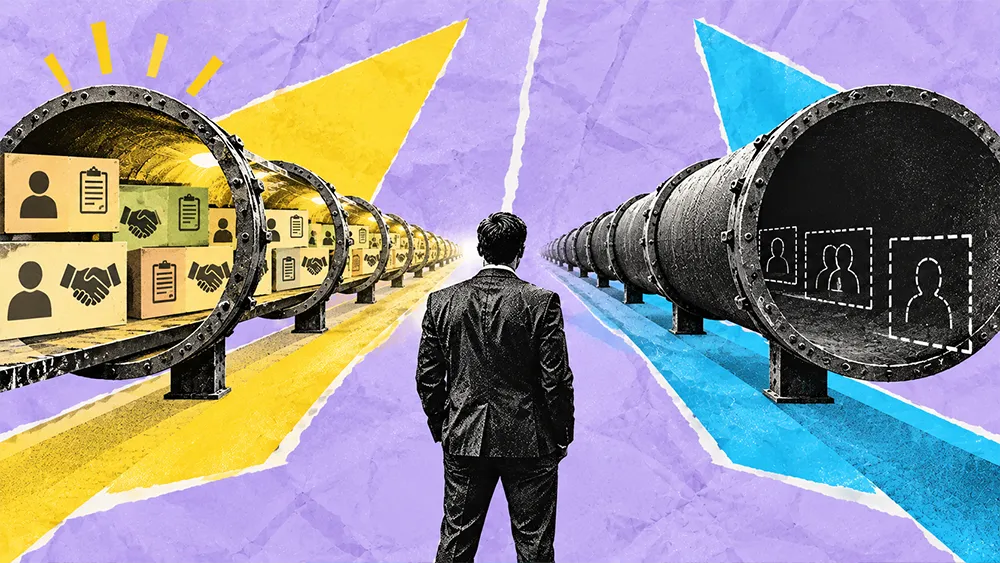

Local Media Sellers Led With Finished Creative Instead of Pitch Decks. They Closed $5.9 Million in Ad Spend.
Seven months of data from 50+ local media companies show what happens when reps lead with a finished ad instead of a proposal. Deals run a third larger, 78% of wins are net-new business, and streaming is closing in on broadcast.
Make Ad World News one of your go-to sources on Google


Walmart paid $1.4 billion in August for a self-serve platform that sells streaming inventory to small and mid-sized advertisers. Those are the same businesses that, according to seven months of data from more than 50 local media companies, already have the budget to buy airtime. What they don't have is a commercial to run.
Waymark's The State of Spec Video report puts a number on that gap. Built from 412 wins logged by sales teams running its AI video platform between January and July 2026, covering broadcast, cable, and streaming partners in markets coast to coast, the report tracks over $5.9 million in influenced ad spend. Seventy-nine percent of the sellers who submitted a win said the finished video helped them close faster or saved them time.
The report's thesis is that creative production, not media strategy or measurement, was the binding constraint on local advertising. Alex Persky-Stern, Waymark's CEO, has built the company around that premise. "We see creative as the hardest piece of building the done-for-you AI platform that unlocks that giant market," he said. The 412 wins suggest he's not wrong.
Those wins don't cluster in one part of the funnel. Follow-ups after a first meeting came up in 29% of them, scheduled demos in 27%, and pricing conversations in 26%. AI created the first draft in 54%, pulling photos and a logo straight off the advertiser's website. The even spread suggests spec-first selling has become standard operating procedure, and that once a rep has a finished spot, they're deploying it at every stage of the deal.
Production as the pinch point
The constraint practitioners describe hasn't changed in decades. Travis Flood, Executive Director of Insights at Comcast Advertising, works with advertisers who want to be on television and can't get there because the handoff between a media seller and an outside production house takes too long. "We've always had that challenge with customers, but then we've had to connect them with a production group," said Flood. "They've had to take 30, 60, 90 days to produce it."
Cost ran parallel to time. Anant Joshi, Director of Business Development International at Magnite, helped commercialize streamr.ai, an AI creative generator for small and medium businesses. The advertisers he works with could afford the media but couldn't afford the ad. "The main barrier that we had before was these SMEs didn't have the capabilities of spending $10,000 on a video ad, whereas they might be happy to spend $5,000 or $10,000 on media," Joshi noted.
These aren't niche cases. The report's verticals data shows production latency hit hardest exactly where it would be expected: categories with real budgets, no in-house creative team, and time-sensitive buying windows.
Bigger deals, earlier creative
About 18% of the logged wins started with a rep building a finished spot for a prospect they'd never spoken to and attaching it to a cold email. Those deals came in at a median of $7,250, roughly a third more than the $5,500 median for wins where the spot arrived later. Waymark's read is that the finished ad bought access. In one case a rep credited it with landing a general manager's time for a first call.
These are self-reported wins, and the sample keeps no record of the deals that went nowhere. What it does capture is how the money distributes once it lands. Auto logged the largest average deal at about $42,000 across 11 wins, with healthcare and wellness next at $21,200 across 25. Home and property services influenced the most spend overall, roughly $1 million across 35 wins, a category the report describes as considered purchases with real budgets and, almost always, no creative team on staff. Events and seasonal advertisers logged the most wins by count at 69, with an average deal of $11,200, in a category where the buy is booked against a fixed date and turnaround speed is the entire value proposition.
First-time TV advertisers
Net-new business made up 78% of the logged wins, and the verticals driving that number tell the same story the rest of the data does: home services, events, healthcare, auto. These are categories where advertising budgets exist and creative teams don't.
Some of those advertisers are arriving on streaming for reasons that have nothing to do with production. David Nyurenberg, SVP of Digital at InterMedia Advertising, sees smaller brands testing streaming because their existing channels ran out of room. "I'm seeing more and more brands come and tell me that they're maxed out on the Googles and the Metas of the world," Nyurenberg said. "They need a new channel to diversify into."
Both paths converge on the same problem. The advertiser has a budget and a reason to move into video. What they don't have is a 30-second commercial scripted, produced, voiced, and delivered to broadcast spec.
Streaming's creative on-ramp
Streaming accounted for 134 of the logged wins and $2.09 million in influenced spend, close behind broadcast at 171 wins and $2.19 million, and ahead of cable and digital combined. That near-parity is the report's forward-looking signal. The advertisers moving budget into streaming are often the ones who have never made a television commercial, and the media buy alone doesn't put them on air.
Social-first advertisers feel it first. Buying streaming inventory now takes about as much effort as buying search, but a 30-second commercial still has to be scripted, shot or generated, voiced, and delivered to spec before a single impression runs. Flood has watched these advertisers stall at exactly that step. "A lot of brands that were previously social first, if you want to create a social ad, you can do it just like that," he said. "Now you want to get into CTV, but what would my commercial be?"
The buying side is already moving. What Walmart's Vibe acquisition signals at the platform level, the report's streaming numbers confirm at the seller level: the money is shifting, and the advertisers behind it are the ones who've never made a commercial.