

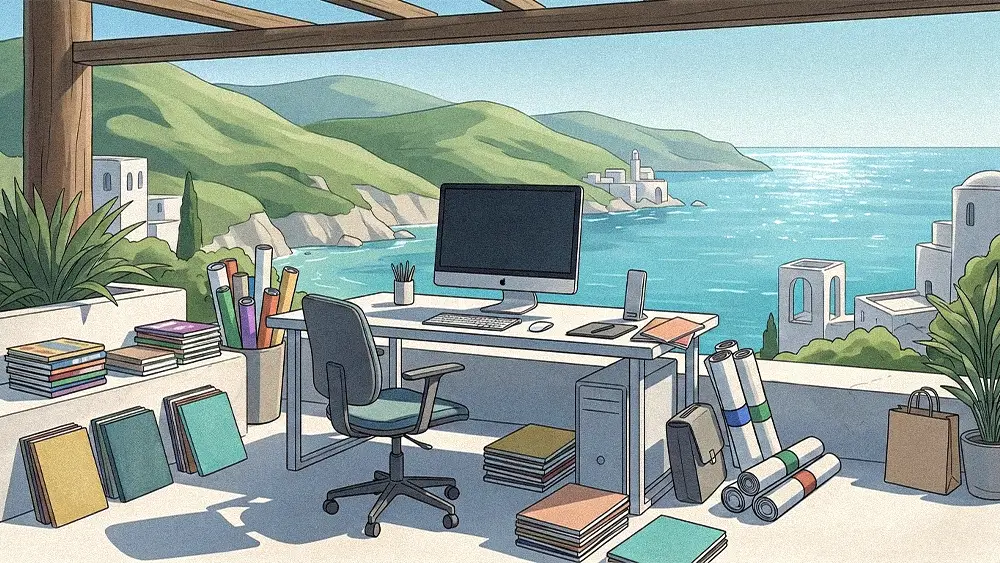
When you live in a smaller place, you have fewer distractions. The mind is clearer, and it's easier to find more original ideas because you are not surrounded by advertising, design, and the chaos of a big city.
 Anselmo TumpićExecutive Creative Director & Co-Owner @ Studio Tumpić/Prenc
The old assumption that running a serious creative agency required a New York, London, or Milan address is losing its hold on the industry. As traditional agencies navigate a market where Madison Avenue is in crisis, a growing set of independent studios operating from smaller regional cities is producing work that competes globally. Stepping away from the noise of major advertising capitals turns out to be a strategic advantage that gives boutique studios fewer distractions and the room to produce more original work than the hub-based agencies chasing the same brief.
Anselmo Tumpić, Executive Creative Director and Co-owner of Studio Tumpić/Prenc, runs a boutique creative agency out of Rovinj, a small coastal town in Croatia, by deliberate design. His decision to build a studio far from traditional hubs came after more than a decade holding senior creative roles at global networks like Saatchi & Saatchi and BBDO in Milan, following formative years at Fabrica, Benetton's communication research center.
"When you live in a smaller place, you have fewer distractions. The mind is clearer, and it's easier to find more original ideas because you are not surrounded by advertising, design, and the chaos of a big city," says Tumpić. The constant advertising and design saturation of a major hub like Milan tends to shape what a creative brief looks like before the team starts thinking about it. Living closer to nature produces a different kind of mental input on the front end. The digital infrastructure the studio runs on keeps it connected to briefs, clients, and standards at the same level as agencies operating out of New York or Milan.
Building the case to stay local
The studio's small size and single-location team let ideas move from brief to execution without the political friction that slows larger agencies down. The structural agility supports ambitious creative work, because award-winning campaigns require client trust that a smaller team builds more quickly. Studio Tumpić/Prenc's Cannes Lion is recent evidence that regional firms can compete at the global creative standard. "Compared to a big agency, the process in a small studio is easier because things move faster," Tumpić says. "The communication doesn't get stuck in misunderstandings, because everything is more direct with the client and with all participants in the creative process. We are all here, all in the same place."
Operating out of a small coastal town shrinks the available talent pool mathematically, but the studio offsets that by giving young Croatian creatives a viable reason to stay home. Croatia, like most smaller European nations, contends with a persistent brain drain as young professionals migrate to Zagreb, Italy, or other larger creative markets for career opportunity. The studio's operating model gives local talent access to meaningful project work at global standards without the geographic move that used to be the only path to that kind of work. "We give young people the opportunity to work on something interesting and stay in Croatia, so they don't need to move," Tumpić explains. "People can stay here and enjoy the quality of life."
For a studio operating outside the major creative circuits, industry awards function as more than recognition. While some high-profile shops are pulling back from Cannes Lions to cut budgets, regional boutiques treat these events as their most direct connection to the global creative community, and their strongest evidence for prospective clients evaluating whether a small studio can deliver on ambition. "Because we are dislocated, competition is really important," notes Tumpić. "This generates a new cycle. Awards give us recognition, and recognition gives us new clients."
Trust, from Zagreb to Cannes
Winning international awards carries additional weight given the realities of the local market Studio Tumpić/Prenc operates in. Croatia transitioned from a state-controlled system to a free market only about thirty years ago, and the commercial advertising culture is still maturing on that timeline. "Thirty years ago, Croatia lived in a completely different system. It was not a free market, so the client culture has to mature," Tumpić says. "You need to have a partner in the client, someone willing to make improvements in the approach. By building this trust, we can make projects like the one that won at Cannes."
The trust dynamic Studio Tumpić/Prenc navigates locally is the same one operating at every level of the industry. Tumpić has served as a Cannes Lions judge, and evaluating campaigns across global markets has confirmed for him that geography doesn't change the underlying requirement. Whether an agency operates out of Milan, New York, or a small coastal town, ambitious creative work reaches the market only when the client trusts the team enough to approve it. "When I saw the projects in Cannes, I believe all of them were made because of trust between the client and the agency," Tumpić concludes. "The client trusts the agency, and the client trusts the creativity. Without that, the project never goes out."