
Buddig Takes a Social-Born Grandmother to CTV Because Feeds Couldn't Give Her Enough Time
Matt Barlow, VP of Brand and Commerce Marketing at Buddig, and Havas Chicago's Brett Terblanche on what changes when a mascot built for the feed moves to connected TV.
Make Ad World News one of your go-to sources on Google


On social, you need to tell a quick story and it needs to be engaging right away. CTV allows it to breathe a little bit.

Matt Barlow
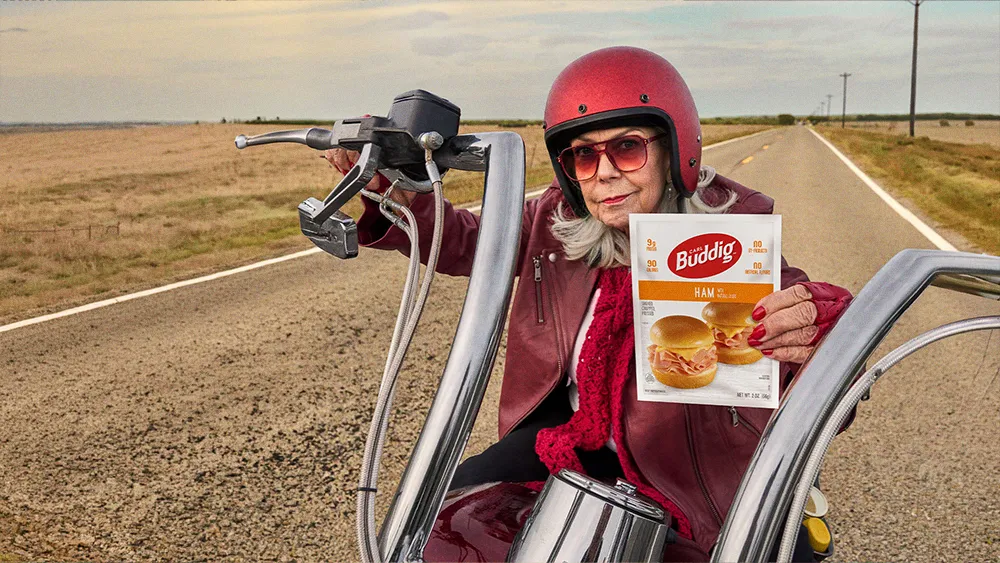
A grandmother in a red leather jacket pulls up beside a biker on the highway and hands him a slice of lunchmeat. A traffic officer working the beat gets one pushed into his mouth. Neither moment is announced, and neither would survive a social cut. Grandma Buddig, the character fronting a family-owned deli meat company that's been selling affordable thin-sliced product to American households since 1943, spent her first year crashing get-ready-with-me routines and ghost-hunting videos in feeds. This summer she's carrying a directed 30-second film on connected TV, running through September. The format shift is the story.
Matt Barlow is Vice President of Brand and Commerce Marketing at Buddig, whose parent company also makes Old Wisconsin snack sticks and Kingsford barbecue. He came to the brand after marketing roles at Bel and Sun-Maid Growers of California. Brett Terblanche is SVP, Group Creative Director at Havas Chicago, which won Buddig's creative and media business in 2025 and has since helped launch the company's Yumbo meat stick line. Terblanche has worked on Hilton, AutoZone and Choose Chicago during his time at the agency.
Barlow's case for CTV starts with what social couldn't solve. The brand has strong awareness and genuine warmth among consumers, but most of that warmth lives in the past tense. "We hear a lot of our consumers talk about, 'Oh, my mom used to always have it in her fridge,' or 'I have such nostalgia for that brand.' Which is great. But what about now?" he says. Buddig's problem is consideration, the gap between a consumer who remembers the brand fondly and one who actually puts it in the cart. Social built Grandma Buddig's recognition. CTV is where Barlow is trying to convert that recognition into purchase intent.
CTV bought time the feed wouldn't give
The film runs 30 seconds and spends them on two payoffs that arrive without warning. A hand reaches into the frame first, and Grandma's face appears behind the biker after it. Later the traffic officer gets a slice pushed into his mouth. Both beats depend on pacing. A social-first edit would need to frontload them, and the surprise would be gone.
Barlow sees the channel as a targeting and measurement play wrapped around a storytelling format. "CTV allows us to reach the exact groups we want to reach while getting accurate KPIs on how it's performing," he says. Reading performance while a campaign is still running tells him whether spend is returning what it should. Video buyers across the industry are pressing for outcomes on every placement, and Barlow uses that visibility to hold the campaign accountable in the consideration space where Buddig needs to grow.
Social runs alongside CTV, and Terblanche treats the two channels as different jobs. "On social, it's key to not feel like an ad. To stop someone from scrolling, it needs to be disruptive, a little unexpected," he says. A grandmother in a leather jacket next to a six-foot-five biker is inherently thumb stopping, but the social extensions don't just cut down the commercial. They build on the character and idea in ways designed specifically for how people engage with content in their feeds.
Barlow frames the relationship between the two platforms as complementary clocks. "On social, you need to tell a quick story and it needs to be engaging right away. CTV allows it to breathe a little bit," he says. The Grandma Buddig campaign was built for feeds first, where work has to land in the first second or it doesn't land at all. Moving her to CTV gave the creative team a format where restraint could actually pay off.
The creative choices CTV made possible
That restraint shaped every decision in the film. Terblanche steered the scripts away from broad gags early because the format gave him room to let viewers find the jokes on their own. "It was so easy to come up with slapstick scripts. The challenge was letting the humor feel authentic and natural to who this character is," he says.
The character was designed against a stereotype. Advertising has a default grandmother, and she pours tea by a window. "Grandmothers have these full, rich lives. They're layered, and they have a little edge to them," Terblanche says. "She's a caring grandmother who happens to be a badass at the same time."
Casting made the edge real. The performer playing Grandma Buddig rode with a biker group in her youth, a detail the agency only learned on set. "Seeing this character sitting on the bike, that's why it felt so authentic, because she actually lived that experience," Terblanche says. That kind of detail reads on a CTV screen in a way it can't in a three-second social scroll.
Barlow points to the product as the license for the tone. "We're not selling life insurance. It's lunch meat. We have the permission to play in that area," he says. Terblanche puts it more simply: "We're not saving lives. We're selling some delicious ham." The film was directed by an award-winning duo called the Grandmas, working through Academy production company in Los Angeles. Two Grandmas on set, one fictional and two behind the camera.
Grandma Buddig never tries to convince anyone to eat the product. "Reminding them is important because we stand behind the product," Barlow says. "Her line is always 'Eat your Buddig.' It's a reminder, not a pitch." The distinction matters in a grocery aisle where every brand is competing for a shrinking budget. A reminder assumes the relationship already exists.
Building equity one format at a time
The campaign came out of real friction between client and agency. Barlow notes that both teams pushed hard on different elements. "Strong pushes from both sides ended up making the spot that much better," he says. Terblanche frames it as mutual trust with a purpose: "The client side trusting the agency to do what's right by the brand, and us understanding they know their brand. Where those two meet, you create work that stands out."
Where Grandma Buddig goes next depends on how this CTV run performs and what the business needs afterward. Buddig's sales team and retail partners are already asking for her, and the brand is being deliberate about when and where she appears. Barlow keeps coming back to consistency as the thing that separates a character from a one-off stunt. "What makes a mascot successful is consistency over time. That's how you build equity in a character," he says.
Terblanche wants to protect the quality that makes her work in the first place. "I love leaning into the mystery of who this grandmother is," he says. "Will she appear? We don't know. How will she appear next? We don't know." After a year in feeds and a summer on connected TV, the answer to what comes next is deliberately withheld. That's the point.