
You've got a good chance of engaging the user if you tell a really good story and you've got the length of time to do that.
 Sarah LewisGlobal Vice President, CTV, ShowHeroes Group
Viewers can't report everything they do in front of a screen, and that limit shapes every creative brief. A message on social has to land in the first two seconds, while a viewer settled into a streaming show gives an ad far longer. Creative built for one screen's rhythm wastes money on the next, and surveys alone rarely show where the rhythm changes. Sensors worn by viewers in their own homes can show it.
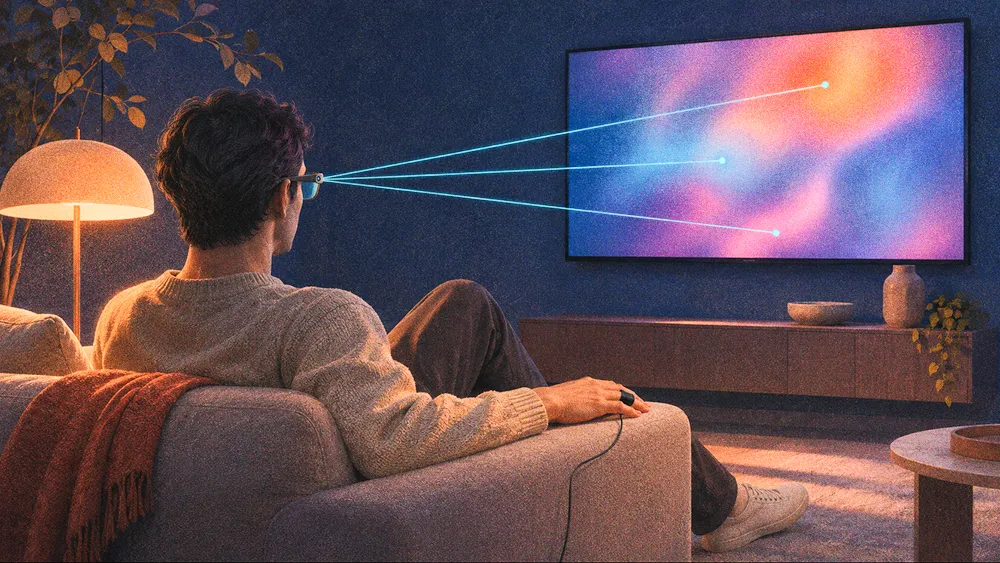
Sarah Lewis, Global Vice President of CTV at ShowHeroes Group, leads connected TV strategy for the video advertising company across Europe, Latin America, the US, and APAC. She joined in 2021 to build its CTV department after a career that ran from the BBC and AOL to the ad-tech platform SpotX, and she has worked on CTV for about eight years. ShowHeroes has commissioned research since 2022 that puts eye-tracking glasses and skin-response sensors on viewers in their living rooms, and Lewis explains what that data has changed about how advertisers should build for the big screen.
"You've got a good chance of engaging the user if you tell a really good story and you've got the length of time to do that," Lewis says of long-form content on the big screen. Her team's studies measure what holds attention by tracking where viewers look and how their skin responds, and the findings give creative and media teams a way to match story length, format, and next steps to the screen in front of the viewer.
Surveys miss what viewers do without noticing
Lewis values surveys for the motivations and stated behavior they capture. Her team wanted the layer beneath. There's a lot "we as humans don't know we do and won't admit to," she says. She chose a biometric approach after taking a TV research course in the UK that used studies of unconscious behavior to test assumptions about second screening. For CTV, she found no equivalent, since most research at the time sized the market.
The first biometric study, which ShowHeroes commissioned from COG Research, fitted 30 UK participants with eye-tracking glasses and finger sensors that track skin response while they watched content of their own choosing at home. Gaze shows where a viewer looks, and skin response adds how engaged the viewer is. Lewis describes a range that runs from low engagement through passive and highly engaged viewing to overload. Social and YouTube scrolling can tip viewers into overload, which cuts retention. The target is the middle, with the viewer looking at the screen. The sample was small and the research is the company's own, so the findings are a signal to test in other campaigns.
Creative length should follow the screen
On social, Lewis says, the key message belongs in the first two seconds, and six seconds is a good length. CTV gives creative more room. In that study, viewers held attention on CTV ads for 12.2 seconds on average before looking away. That's enough time to build a story.
Screen size and content type matter too. Lewis says long-form content on the big screen, such as a movie or a TV show with non-skippable ads, gives an advertiser a good chance of engaging viewers with a strong story. Clear, concise creative helps, and standing out takes work interesting enough to capture the audience. "Boring loses you money," she says.
The second screen gives viewers a next step
Second screening doesn't pull viewers away from the TV, Lewis says. "It doesn't lessen the attention." In her view, a phone in the viewer's hand gives advertisers a chance to extend the spot with cross-screen targeting, measurement, and creative adapted to the second screen.
QR codes are the first tool. They've become far more integrated in everyday life since the pandemic, Lewis says, so a viewer already on a phone can scan a high-quality code with little effort. Her team also builds animated codes to make them fun, eye-catching, and engaging. She describes sesame seeds thrown across the screen for a burger brand and the pins on an electric vehicle charger turning into codes. A viewer whose interest the ad has captured finds it easier to scan, which extends the experience with the advertiser off screen.
Voice commands suit viewers with a smart speaker in the room. Lewis says a viewer can ask for more information about the brand, and the speaker sends it to the app on their phone, which moves the experience onto another screen. Advertisers can also use it to send a discount code. She says the format is growing as smart speaker volumes rise and deserves attention in any market where they're common. Both tools follow the same principle for her, which is making the action as frictionless as possible for the viewer. "That's going to win in the end," she says.
Home screens are the next place to measure
Lewis's studies covered in-stream ads only. Her next question is how viewers behave on the home screen, where choice fatigue builds. For advertisers, that screen offers a first impression, and she says first impressions are hard to get on other screens. Lewis wants to learn which ad formats fit that environment, look native, and feel premium.
Her latest research looks at how viewers pay for streaming, with subscription fees, with attention to ads, or both. A recent ShowHeroes survey with Omnicom Media Netherlands covered 4,377 respondents in six European markets. Households held two to three paid streaming services, and 37% said they would cancel one if ads arrived without a meaningful price cut. Lewis says the work asks viewers whether they realize what they're paying with, which means the exchange has to feel fair to them. She sees the home screen as a place to capture viewers "as long as it looks good and it fits with the experience."