Saying, 'Here are the benefits of the coil in your HVAC unit,' is going to be a lot harder than saying, 'Check out these crazy animals and pay attention.'
 Hannah AbeSenior Director of Growth, Filterbuy
Air filters are a category where attention is still winnable. The products mainly sell on price and availability, which is usually where most of the advertising money goes. A brand that goes after memory spends its airtime making an impression instead of simply listing what the product does. Doing so takes an idea a viewer can repeat, and one with somewhere to go after the first spot has run.
Hannah Abe is the Senior Director of Growth at US-based air filter manufacturer Filterbuy. She arrived from the pet apparel brand Canada Pooch, where she led growth marketing. Earlier, she worked in acquisition and paid social at MVMT. David Yankelewitz is Founder and Chief Creative Officer of PDA, a remote agency that staffs each project from a network of senior creatives and producers. PDA counts Dr. Squatch, Netflix, and LEGO among its clients, and Yankelewitz led creative on Verizon at R/GA. Abe's team brought PDA the assignment.
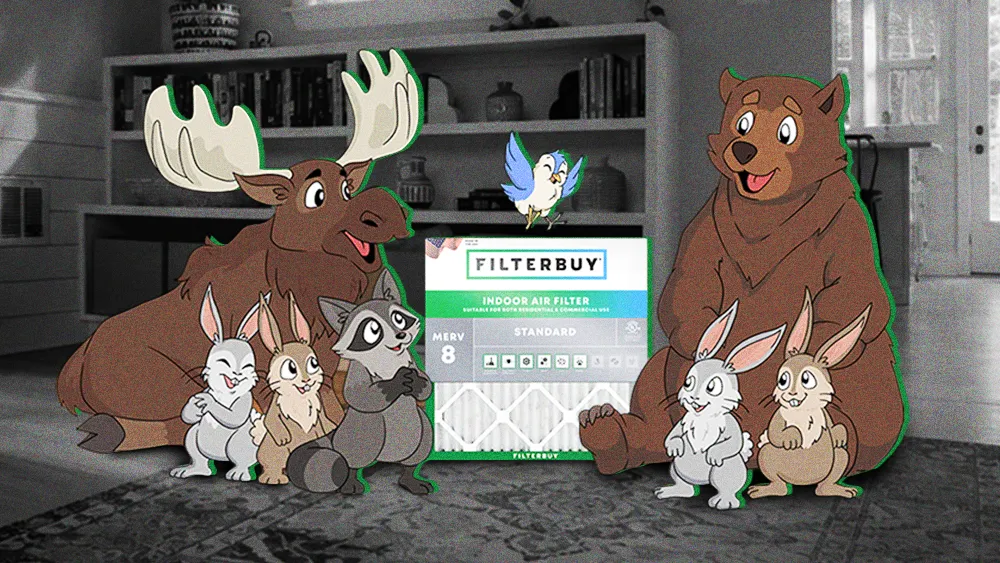
"Saying, 'Here are the benefits of the coil in your HVAC unit,' is going to be a lot harder than saying, 'Check out these crazy animals and pay attention,'" says Abe. Clean air is ultimately what Filterbuy sells, and Abe says the company had spent years looking for a way to make that tangible. PDA's answer was a television spot called Fresh Air for the Great Indoors, and it makes the benefit literal. On screen, a cartoon moose, a group of raccoons, and other wildlife ambush a family's home while panic ensues for the people who live there.
Memorability before benefits
Yankelewitz and Abe agreed early to keep the product claims to a minimum, and the decision held all the way through production. A filter offers a writer very little to dramatize, and Yankelewitz wanted recognition before comprehension. "At least at this stage, we didn't get too deep into all the RTBs," he says. "As long as you get the benefit, the brand name is in mind, and you remember it, then we've achieved our goal."
The script lost most of its selling copy on the way to the shoot. "Originally we did have some value props being called out, but we ended up cutting it in favor of some of the more animal running, noise, screaming, horror, the humor of it," says Abe. The spot still opens like a conventional home-products ad and then drops the act about seven seconds in. "How this spot starts and then immediately is flipped on its head, that is something we want to continue to do," she adds.
Letting the idea lead
Filterbuy and PDA discussed budget in their first conversation, before PDA had shown any creative. Each side also said where it stood on using AI and what values it wanted the work to carry. "We also had a lot of transparency in our partnership, even from the budget discussions, from the very beginning of us sharing what was feasible for us," Abe explains. "Then that kind of shaped what the different creative angles could be."
PDA brought about a dozen ideas to the pitch, and Filterbuy chose the one that could run furthest past a single spot. The chosen idea needed a live-action shoot, with hand-drawn animation and illustration laid over it, plus AI processes on a few static backgrounds. "After that, it was just about the strength of the idea," says Yankelewitz. "What do we love most conceptually? And what do we feel like can be a campaign that lasts and can extend into different places? Then we ask ourselves the question of what's the best way to produce it."
Some of the concepts PDA pitched were built for generative AI, and a few mixed AI with live action. The one Filterbuy chose happened to need a camera. "We used very little AI in the end for this spot, and not because we didn't want to. Other concepts that we pitched would have been much more reliant on AI just because they were ridiculous," notes Yankelewitz. "I'm not one of those guys that's against using AI for creative. I think it has a role."
What I like about this concept is that it comes with a world and characters who were fun and instrumental for the campaign. It gave an interesting contrast between indoor and outdoor that we can play with in different ways in the future.
 David YankelewitzFounder & CCO, PDA
Room to keep going
Filterbuy came to the pitch with a budget for two videos, but the concept it chose had enough in it to make the company widen that scope before production began. "What I like about a concept like this is that it comes with a world and characters who were fun and instrumental for the campaign," Yankelewitz notes. "It gave an interesting contrast between indoor and outdoor that we can play with in different ways in the future."
Yellow Sweater produced the shoot in a single day at a rental house. A puppeteer crouched behind the kitchen counter with his hands inside a potato chip bag, standing in for the raccoon that gets its head stuck in it. The two children on camera were the director of photography's own. "When we were directing mom and the kids in that shoot, we said, 'All right, this is going to be funny if it feels like real horror, you have to actually get scared,'" says Yankelewitz. "But then the animals were cute and charming, so we're finding that balance."
A "Great Indoors Survival Kit" also went out inside product shipments and to creators. Their videos became campaign content too, alongside a microsite and an email program. "We've got people unboxing their Survival Kit, or a few creators who have a lot of wildlife of their own coming into their home and kind of extending the skit themselves," says Abe. Yankelewitz wants every pitch to leave a client that much to work with. "We always want to deliver ideas that are sauce that is this spicy, or soup that has enough ingredients so that you can take it there if you want to," he says.
Judging the work
Filterbuy sets the new spot beside its own earlier ads and reads each channel separately. Abe is candid that the exercise is partly instinct. "It's a mix of art and science. We have other assets, not at a campaign level to this degree, that we can do some close comparisons on," she says. "How is it performing on TV relative to some other stuff we've tried on TV, on social, with our influencers? We can do that kind of gut check to understand on a creative level how it's performing against other creative."
Abe credits PDA with the idea, and it now runs through every part of the campaign from the spot to the survival kit. "The piece that's encapsulated in this creative that we do want to continue is just that feeling of doing something unexpected," she says. "How we continue to do that can evolve, and maybe it looks like these characters breaking in again or into different scenarios. PDA did a great job in capturing that," she concludes.