
Inside Svedka's Plan To Serve A Different Vodka Ad For Every Drinking Occasion
Sazerac CMO Sara Saunders on how Svedka uses AI to turn one campaign into an occasion-based system, adapting creative by time and market while humans stay in control.
Make Ad World News one of your go-to sources on Google


If an ad didn't work, kill it and move on. AI makes it much easier to learn faster and get to the next idea.

Sara Saunders
Most brands still treat a hero ad as a finished object, shot once and pushed out everywhere the same way. Svedka is running the opposite play. The vodka brand is using AI to turn a single creative idea into an occasion-based system, reshaping the same assets by time of day, setting, and market so the right version reaches a consumer at the point they're most likely to reach for a drink. The Super Bowl spot proved the model can move the numbers. What comes next: an AI-built campaign for the brand's new vodka water, treating production speed less as a cost-saving and more as a learning engine, where the real advantage is testing ideas against reality faster than a traditional shoot would ever allow.
Sara Saunders is Chief Marketing Officer at Sazerac, the spirits company behind Buffalo Trace, Wheatley, and Svedka. Saunders joined Sazerac in 2021 and oversaw the brand's revival after the company acquired Svedka from Constellation Brands in early 2025, a stretch that took the label from steep decline back into growth. Her team's willingness to gamble on emerging tools set up one of the year's most closely watched advertising experiments.
"If an ad didn't work, kill it and move on. AI makes it much easier to learn faster and get to the next idea," says Saunders, framing production speed as a way to fail cheaply and iterate quickly rather than a way to trim budgets. That posture shaped every decision around Svedka's Super Bowl debut, the first primarily AI-generated national spot to run in the game. The wager was simple: a recognizable mascot plus generative tools would get people talking. The numbers that followed say it worked.
Storytelling over efficiency
Saunders has been clear that AI's value for Svedka was never about saving money. The 30-second spot required roughly four months of work to reconstruct the Fembot character and train models to mimic her facial expressions and movement, an effort that undercuts any idea that AI made the ad cheap.
"It's never been an efficiency play for us, it's been a storytelling play," she says. Reviving a mascot that had been retired for over a decade gave the brand a recognizable anchor, and pairing her with the new Brobot gave AI something specific to build around rather than generic footage. The result put a polarizing category, vodka, on advertising's biggest stage with a point of view sharp enough to earn debate.
The numbers behind the bet
The commercial did what a revival campaign is supposed to do. Svedka has become one of America's fastest-growing liquor brands, posting 16.7% year-over-year growth over the 26 weeks ending in April 2026, a stretch that runs directly through the February game.
The momentum held into summer. Svedka ranked among the top five fastest-growing spirits brands by dollar value in NielsenIQ channels in the four weeks through July 11, rising 16%. Saunders points to that kind of tracking as the reason the Super Bowl gamble made sense for a brand still reintroducing itself to younger drinkers who carry no fixed perception of it.
Right asset, right consumer, right time
The larger ambition sits underneath the individual spots. Saunders describes a system built to match creative to the exact conditions of a drinking occasion, adapting a single idea across the variables that shape when and why someone buys.
"We have a lot of passion for figuring out how to get the right asset to the right consumer at the right time. AI unleashes that for us in a way that traditional creative could not," she says. A conventional shoot locks a brand into a handful of finished cuts. Generative tools let the team spin the same concept into dozens of context-specific versions, a rooftop party in peak heat reading differently at 4 p.m. than at 9 p.m., or a coastal market seeing a different edit than a landlocked one. The speed to react in real time becomes its own form of relevance.
Humans stay in the loop
Saunders is firm that even with AI doing the execution, the decisions still belong to people. Creative professionals developed the storyline and oversaw final production, with AI handling execution inside a framework the team directed rather than replacing the judgment behind it.
That hybrid model, machine speed under human control, is the part Saunders expects to spread across the industry. The Super Bowl spot even coded the message into its own plot, with the robots returning to remind humans to put down their screens and connect in person. The tools scaled the output while the point of view stayed with the people who set it.
Clear can, faster learning
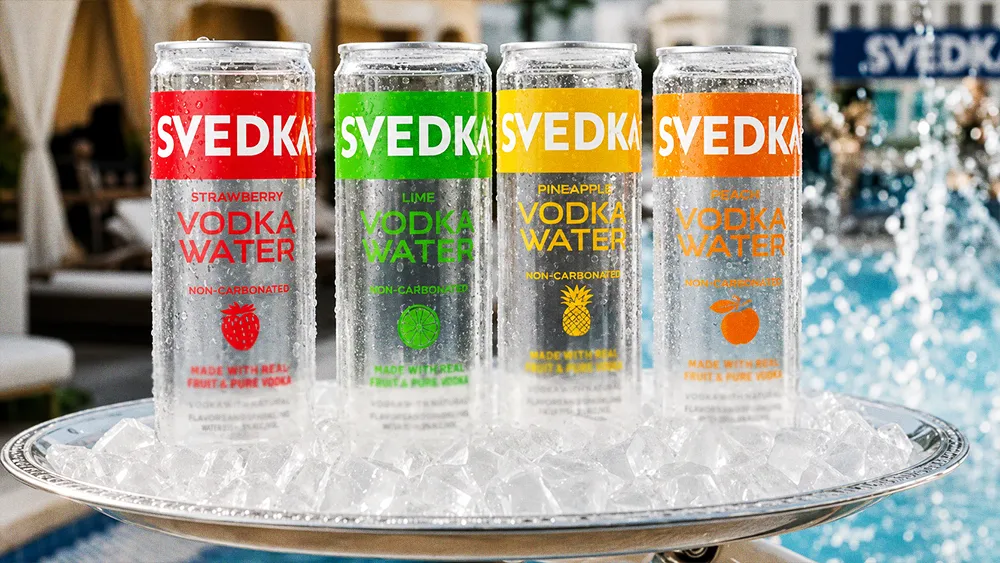
The approach now moves to Svedka Vodka Water, the brand's transparent canned RTD that launched nationwide in June across four flavors. The line arrives as ready-to-drink formats reshape the category, with RTDs surpassing vodka in global value last year, and it gives the AI system a fresh product to iterate against. An AI-built campaign for the vodka water is set to arrive later this summer, extending the same occasion-based logic to a product built for warm-weather, on-the-go drinking.
From the Super Bowl to the can, the constant is a different definition of what a campaign does. Rather than a fixed set of finished assets, Saunders treats creative as a hypothesis to be tested, refined, and replaced at the pace real consumer behavior reveals what works. The distinctive brand world stays constant while the executions flex, which is what lets a single idea show up correctly across the scattered moments when someone decides what to pour.
"If an ad didn't work, kill it and move on. AI makes it much easier to learn faster and get to the next idea," says Saunders. For a brand pulled out of decline in under two years, moving at that speed is what made the turnaround possible.