
Creative Directors Now Build Ensembles To Turn Ideas Into Meaningful Work
Xavier Serrano, CEO of TBWA Colombia, explains why modern creative leadership depends on building an ensemble capable of turning ideas into results.
Make Ad World News one of your go-to sources on Google


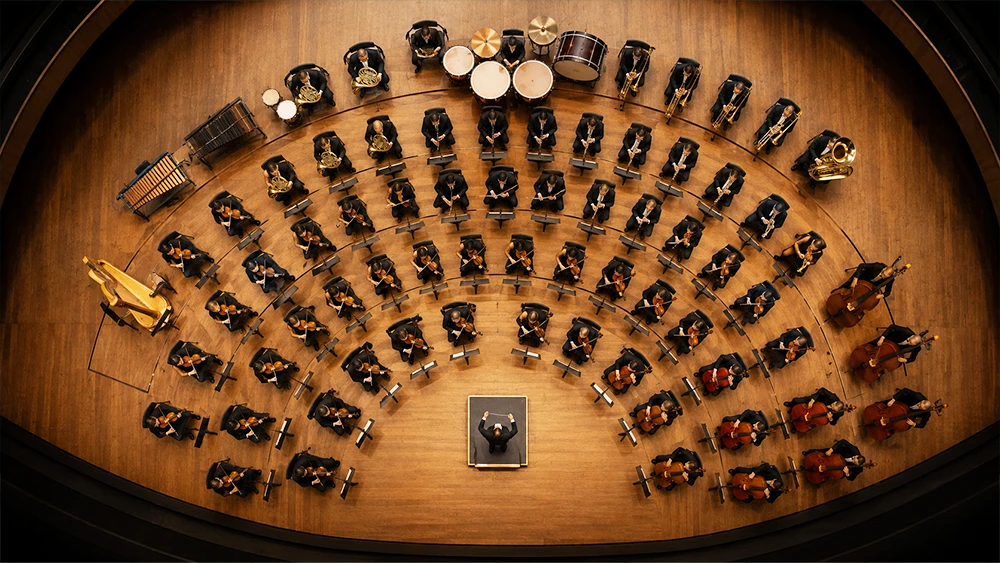
Creativity is becoming global, and the process is becoming teamwork. It is more like an orchestra or a band: you might be great at the piano, but some sounds are better for violins or drums.

Xavier Serrano
The "lone genius" era of advertising is over. The best ideas now come from ensembles, and technology has raised the baseline for production to where the operational question inside creative teams is no longer who has the idea, but who can execute it end-to-end. The widening divide between organizations that leverage modern tech well and those that don't traces back to the same principle: handing a team a generative algorithm without the collaborative structure to run it produces the same result as handing them a blank page. The structure of the collaboration around the tools is what carries the strong creative operations.
Xavier Serrano, CEO of TBWA Colombia, brings a unique combination of operational track record and academic depth to the question of how creative teams actually deliver. He recently led DDB Colombia's 600-person operation to "Best Agency" and "Best Place to Work" status, delivering double-digit KPI growth over three years. He also brings a quarter-century of classroom experience, having taught innovation and leadership at CESA since 2000.
"Creativity is becoming global, and the process is becoming teamwork. It is more like an orchestra or a band: you might be great at the piano, but some sounds are better for violins or drums," says Serrano. The ongoing consolidation of agency teams has changed how strong ideas come together, and Serrano describes the model as an ensemble of four working roles. Someone plays the trigger and originates the idea, a sponsor commits the resources to run it, directors bring the specialized expertise the concept needs to hold up, and builders make the work real. Serrano compares the dynamic to an orchestra or a football team: the visible virtuoso rarely operates without a supporting cast whose contribution shows up in the final result.
Judging ideas against intended outcomes
When an idea gets traction, the collaborative reality behind it often gets overshadowed by the natural pull toward individual recognition. Serrano treats that pull as a predictable behavioral pattern leaders have to actively manage. "When an idea becomes something greater and everybody is talking about it, we need to remember that most people want to be famous," he says. "The reality is that whether you were a sponsor, director, builder, or just a trigger, without the other three, that idea would never exist," Serrano says. For him, the corrective is to evaluate an idea against its intended outcome. "The best way to judge an idea is to understand the results of the idea itself. Judging an idea without a goal is very difficult because you do not know what you are evaluating."
Serrano's ensemble argument has a specific implication for how the industry attributes creative success. He believes solitary creation is a myth, and that the celebrated names at the top of creative-director rankings are usually the visible surface of a specific team dynamic. "I wouldn't give awards to single individuals because I don't believe solitary creation really exists. When I see rankings for top creative directors, my belief is that those people depend heavily on the team they have beside them," Serrano says. The same principle explains why highly decorated creative talent sometimes struggles when they move to a new agency: the work that made them visible was produced by an ensemble that stayed behind.
Serrano distinguishes between generative AI as a tool for driving basic productivity and creative output, and agentic AI as an orchestration layer that connects inputs across teams and reduces mistakes at the production stage. What neither category can do is decide what the work should accomplish or what makes it worth doing, which is why human oversight remains non-negotiable even as the tools take on more of the pipeline. Serrano frames the dynamic through a GPS analogy: the tool optimizes the route once the destination is set, and without a destination the tool becomes a liability. "AI does not have intentions, you need human beings for that," he notes. "If you work in creativity, it is because you want to change something in the world. How it gets better depends entirely on the intentions of your team."
Aligning the ensemble around intention
Leading a creative team that includes AI as one of its instruments requires the same core skill leaders needed before the tools arrived: the ability to hold a group around a shared destination when everyone has a different opinion on how to get there. Serrano treats collective intention as the anchor of modern creative leadership, and the reason the four ensemble roles hold together. "Think of it like planning a family trip. We might debate the route, what sports we will play, or what cities we will visit, but we have all agreed that we are going to new places," he says. "Teams are more successful when they are connected by a greater purpose, even if they have different views on how to get there."
The final differentiator between competent output and meaningful work is the human intention layered underneath the tools. Serrano's argument is that as AI takes on more of the pipeline, the intention behind the work becomes the thing that separates a functional deliverable from something worth doing. Everything else in the ensemble model ultimately serves that intention. "We are putting more technology into the natural part of our human existence, and we are putting more nature in technology. No matter how powerful AI becomes, your intention, what you want to leave for your kids, or create for your teams, is what really matters," Serrano concludes. "Without human intention, you might build something good, but it will just never be great."