
How Red Lobster Tests Every Campaign Idea Against Real Human Behavior
Heather Timm, Senior Director, Advertising & Media at Red Lobster, explains the three questions the team asks before building a campaign, and why the Crabfest Bestie Bib cleared all of them.
Make Ad World News one of your go-to sources on Google


For us, the difference is whether the idea starts with the brand and a real human behavior, or whether it starts with a stunt. We ask ourselves: Would people actually want to do this, talk about it or send it to a friend?

Heather Timm
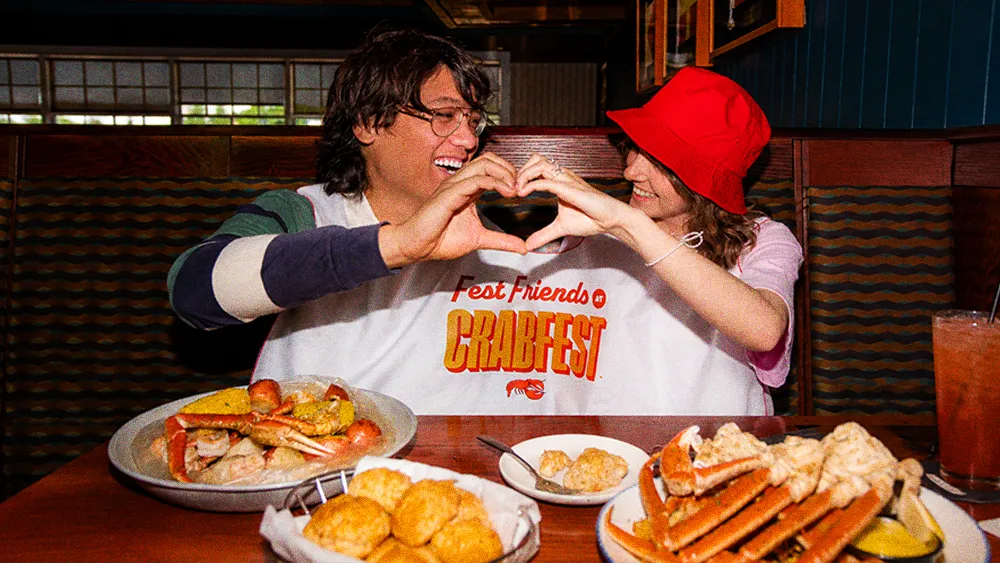
Red Lobster built this summer's Crabfest campaign around a redesigned bib made for two people to wear at once. The Bestie Bib launched in late July with agency partner BarkleyOKRP, timed to International Day of Friendship and produced as a limited run. Some 81% of consumers expect brands to take part in the topics and trends they care about, and they are quick to spot the brands with no real commitment to the subject. Red Lobster's marketing team faces that judgment on every campaign it approves.
Heather Timm, Senior Director, Advertising & Media at Red Lobster, oversees the planning and placement behind campaigns like this one. In her previous roles at Darden, she ran brand marketing for Eddie V's Prime Seafood and The Capital Grille before taking on a three-brand luxury portfolio. Her account of the Bestie Bib turns on a question the team asks of every concept that comes through.
"For us, the difference is whether the idea starts with the brand and a real human behavior, or whether it starts with a stunt. We ask ourselves: Would people actually want to do this, talk about it or send it to a friend? Does it feel unmistakably Red Lobster? And can you understand the idea immediately?" says Timm. The test runs before any budget commits. Any campaign with money behind it can generate impression volume, so the filter targets a narrower measure of whether people carry the idea further on their own. Red Lobster applied the standard to a physical product this time, and the limited run meant the bib had to hold up on its design alone.
Best friend behavior
The Bestie Bib originated in a calendar overlap. Crabfest returned to Red Lobster in early summer with new seafood boils and a build-your-own crab format, and the bib is already standard issue for anyone ordering crab. "Crabfest is about as all-out as Red Lobster gets," Timm says. "When we realized International Day of Friendship fell during Crabfest, the idea was almost comically simple: add another neck hole."
The entry mechanic on Red Lobster's Instagram asked people to comment and tag the friend they would wear the bib with. Limited supply meant most entrants would never receive one, but the tagging happened anyway. Timm treats this kind of organic response as confirmation that the concept was sound to begin with. "If those things are true, sharing becomes a natural byproduct," she explains. "We're not trying to force people to share advertising. We're trying to create something they genuinely want to share."
Setting the participation bar
Red Lobster ran the campaign across four unique formats: Instagram, a custom Snapchat lens, creator partnerships, and local news co-anchor pairs. Timm sets a single threshold that applies across all of them. "It has to be simple, entertaining and just unexpected enough to make you stop," she notes. "If people have to work too hard to understand how to participate, you've probably lost them. And if we're showing up on platforms people use for entertainment, then what we create needs to actually be entertaining."
The team built the participation mechanic into the product itself, which removed the need for instructional copy anywhere in the campaign. At 65% of consumers, food and lifestyle topics draw the largest following of any interest community measured, so photographs of the bib reached an audience already primed for the category. Two wearers also meant two accounts posting, which doubled the distribution of every unit produced. "The Bestie Bib is easy to understand, but there's a twist: two neck holes," Timm adds. "That simple twist gives you a reason to pull a friend in, be a little silly together and make your own moment out of it. The participation itself is part of the fun."
Keeping the brand recognizable
Red Lobster runs guest research year-round, and it turns up more findings than any one campaign can use. Timm's team keeps the ones Red Lobster is positioned to act on and sets the rest aside. "We're constantly learning from our guests," she observes. "We use social listening, customer feedback, surveys and research around things like potential menu additions to understand what people want and how their needs and behaviors are changing. Those inputs make us smarter, but we always bring them back through the lens of Red Lobster: How can we give guests more of what they want in a way that still feels distinctly like us?"
The Bestie Bib required a design collaboration and a limited production run, and it worked from a piece of the dining experience Red Lobster already owned outright. Starting from scratch would have meant paying to make something familiar before it could do any work. Timm expects that comparison to hold for other restaurant brands as competition for attention tightens. "I think brands like ours are going to have to get even clearer about who they are," she concludes. "When attention gets harder to earn, it can be tempting to chase every trend. We think the better answer is to double down on the things people already know and love about you."