


If you tell the platform automation to shoot for clicks, then it's going to hit the mark every time. It's going to shoot for clicks and it doesn't care how to get them.
 Markey DanielsRegional Digital Sales Manager, Cumulus Media
Automated ad platforms are logical machines, and they pursue whatever goal they're handed, whether it's clicks, traffic, or new members. When a campaign underdelivers, the instruction behind it usually left the platform room to succeed at the wrong thing, which means the fix starts before launch.
Markey Daniels, Regional Digital Sales Manager at Cumulus Media, has spent his career in advertising sales, from newspaper accounts to digital sales leadership at Beasley Media Group and Bonneville International. He says most of his digital marketing work over roughly the last three years has centered on how to tell an automation platform what to do. He points to a credit union campaign aimed at new members as an example.
“If you tell the platform automation to shoot for clicks, then it's going to hit the mark every time. It's going to shoot for clicks and it doesn't care how to get them,” Daniels says. A platform that doesn't care how it gets clicks leaves the quality of the result to whoever writes the brief, and in his example that brief started with a single goal.
Automation does exactly what the brief says
Daniels sees automation as a system that works with whatever it receives. “It's extremely logical. But it is also built on goals and it's driven by what you tell it to do,” he says.
The credit union's setup shows how that plays out. Some of its work ran in-house and some sat with third parties, which made daily optimization hard to coordinate. Daniels says the team he worked with came in, studied the market and the prior year, and rebuilt the campaign around one outcome. “The goal was new members,” he says. Clicks still mattered as conversions the team could use, but only the right kind.
The instruction changes with the business
That single goal looks different for every client. A credit union wants members, while in an HVAC example Daniels gives, the sweet spot might be a free estimate that gets a homeowner in the door. “We're not going for selling a whole unit, we're going for sign up for a free estimate,” Daniels says.
The mindset behind the audience differs in each case, even though the basics overlap, such as the homeowner, the age group and the age of the unit, and the instruction supplies the rest. “The logic is telling the model who that is and when to inspire that engagement,” he explains. He adds that the logic can be written as code and uploaded to the platform along with the audiences, the data and the files a campaign uses.
Exclusions clean up the leads before launch
Defining what a platform should avoid deserves the same attention as defining the goal, because even a logical campaign can drive accidental clicks, bots and other browser tricks. “You get rid of the chaff before you start the campaign,” Daniels says.
Timing matters because a new campaign spends its first 30 days in a training period, so the exclusions belong in the first brief. “All the things that you don't want could happen. You have to define that going in,” he adds. Without them, a platform told to chase an audience with a set of demographics will still let quasi-leads through, and each one counts as a hit.
Most of what makes an instruction good never gets written down. The senior person on the team carries the exclusions in their head, and the platform only learns them after money has been spent. Once that list is on paper, anyone can brief the system the same way, and a new hire doesn't have to relearn it.
 Wael SabraFounder + CEO, SiiRA
The exclusion list has to come from somewhere. Wael Sabra, Founder and CEO of SiiRA, which helps companies hire remote engineers and AI teams, spent eight years building data and ad tech products at Cablevision and Altice USA before starting the firm. “Most of what makes an instruction good never gets written down. The senior person on the team carries the exclusions in their head, and the platform only learns them after money has been spent. Once that list is on paper, anyone can brief the system the same way, and a new hire doesn't have to relearn it,” Sabra says.
A dark control zone shows whether the instruction worked
Proving results starts with trust. “The other part of succeeding in a campaign is your client trusts you,” Daniels says, and at a certain point the team asks the client to share data. A gain over the same period last year then raises the question of incrementality.
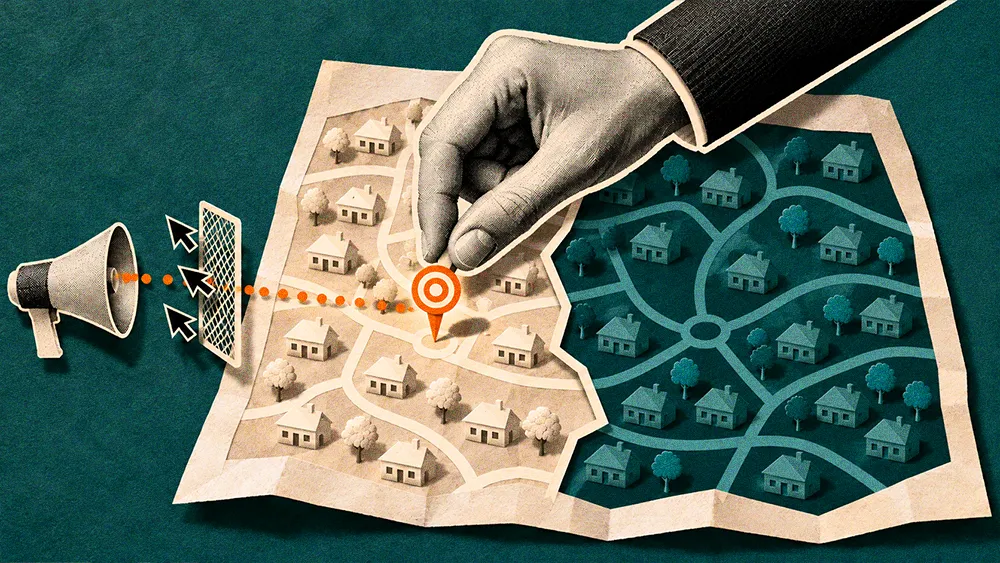
A control group answers that question. “We're going to fly the campaign in the market, and we're going to keep this control group dark, not going to run anything there,” he explains. The team later compares the dark zone with the live zones in a holdout test. In the illustration he gives, the live zone grows 10% and the dark zone grows 2%, so the campaign's own effect was 8%, because the market would have grown 2% anyway. Those numbers are his illustration and don't reflect campaign results.
The way to instruct a platform keeps changing, Daniels says, and he's candid about the misses. “I have wasted time with a model that I thought was just Johnny-on-the-spot, and boy oh boy, it failed,” he says. The lesson he takes from those misses is simple. “You don't get far very fast if you don't fail very fast.”